

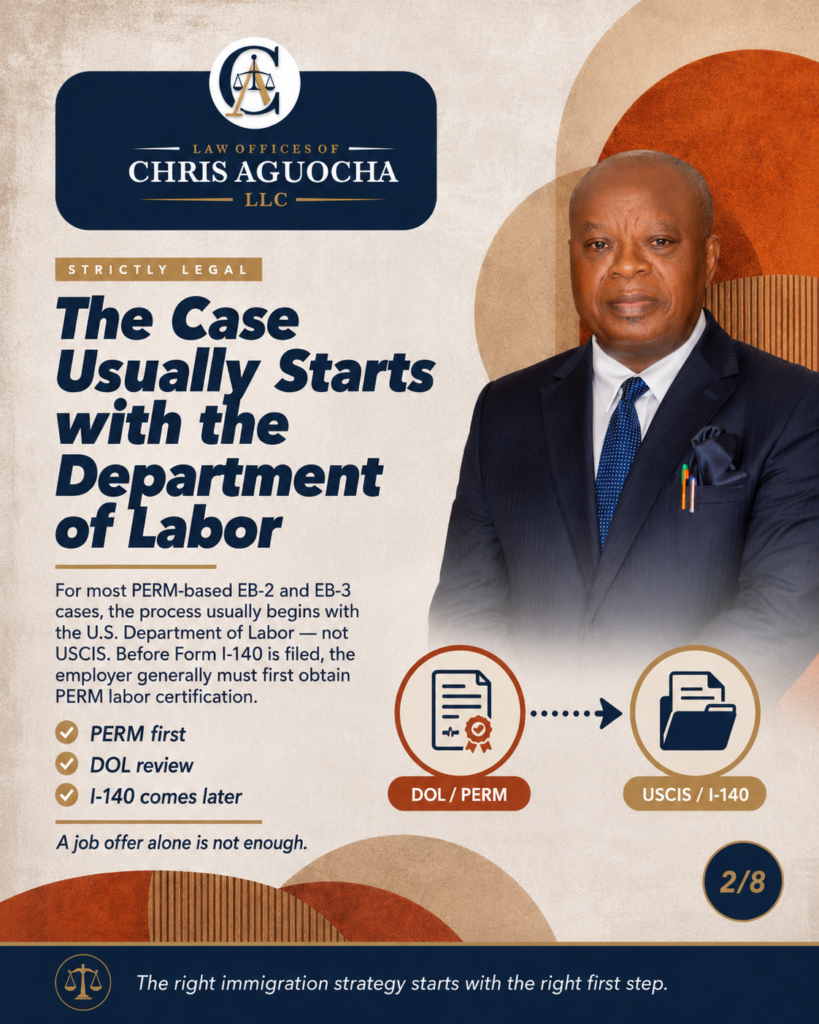





Many employers and foreign workers assume that an employment-based Green Card case begins by filing a petition with USCIS. For most PERM-based EB-2 and EB-3 cases, that is not how the process works.
Instead, the process generally begins with the U.S. Department of Labor (DOL). Before an employer may file Form I-140, Immigrant Petition for Alien Worker, the employer must usually obtain a PERM labor certification, demonstrating that hiring the foreign worker will not adversely affect the wages and working conditions of similarly employed U.S. workers.
A job offer alone is not enough. PERM is a regulated labor certification process with detailed legal requirements governing wages, recruitment, documentation, and employer compliance.
The Prevailing Wage Is the First Legal Step
For most PERM cases, the employer first requests a Prevailing Wage Determination (PWD) from the Department of Labor.
The prevailing wage establishes the minimum wage the employer must be prepared to pay for the offered permanent position based on factors such as:
• Job duties.
• Education requirements.
• Experience requirements.
• Skill level.
• Geographic area of intended employment.
If the employer cannot meet the applicable prevailing wage requirements, the sponsorship may not be ready to proceed.
The Prevailing Wage Is the First Legal Step
For most PERM cases, the employer first requests a Prevailing Wage Determination (PWD) from the Department of Labor.
The prevailing wage establishes the minimum wage the employer must be prepared to pay for the offered permanent position based on factors such as:
• Job duties.
• Education requirements.
• Experience requirements.
• Skill level.
• Geographic area of intended employment.
If the employer cannot meet the applicable prevailing wage requirements, the sponsorship may not be ready to proceed.
The Job Description Must Reflect a Genuine Position
The job offered must represent a bona fide, permanent, full-time employment opportunity.
The position should accurately describe the employer’s legitimate business needs. Problems may arise if the employer:
• Inflates job duties.
• Imposes unnecessary minimum qualifications.
• Tailors the position primarily to match the foreign worker’s background.
• Uses requirements that cannot be supported by business necessity.
The Department of Labor may closely examine whether the stated requirements are reasonable and consistent with the employer’s actual hiring practices.
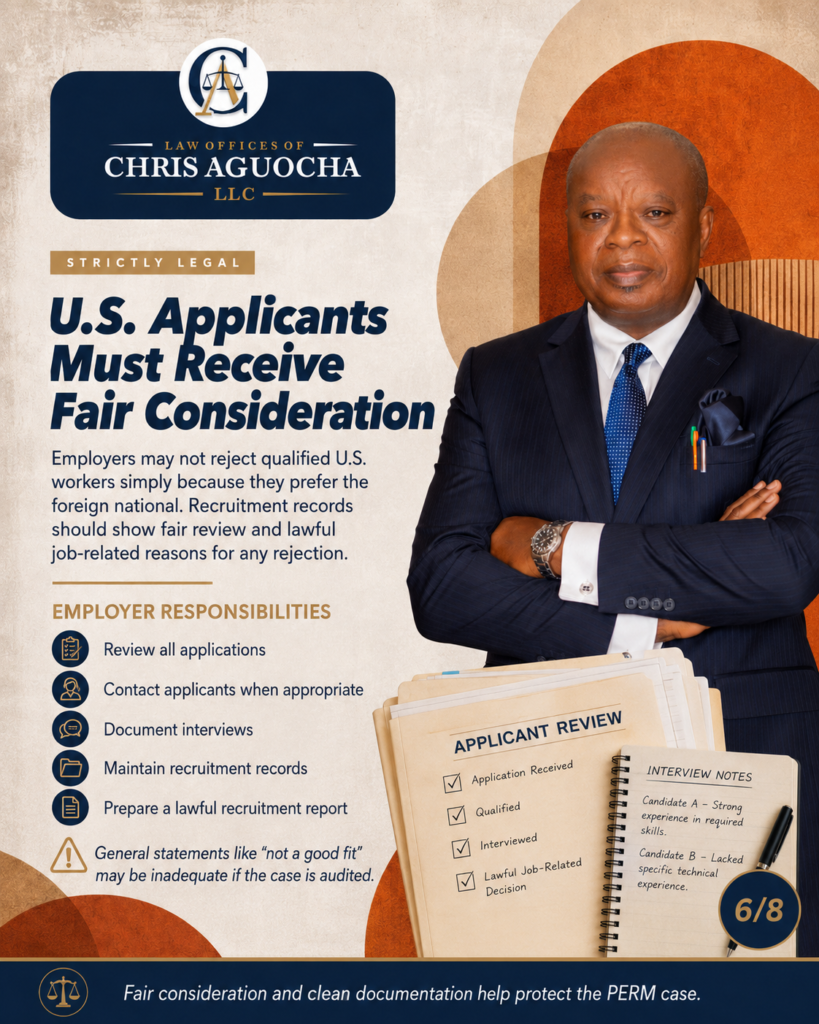
U.S. Applicants Must Receive Fair Consideration
Employers may not reject qualified U.S. workers simply because they prefer to employ the foreign national.
During recruitment, employers should carefully:
• Review all applications.
• Contact applicants where appropriate.
• Document interviews.
• Maintain recruitment records.
• Prepare a recruitment report explaining lawful, job-related reasons for any rejection.
General statements such as “not a good fit” or “preferred another candidate” may be insufficient if the case is later audited.
PERM Is the Employer’s Application
Although the foreign worker benefits from the process, the PERM application belongs to the employer.
The employer is generally responsible for:
• Defining the position.
• Conducting recruitment.
• Maintaining recruitment documentation.
• Complying with Department of Labor regulations.
• Demonstrating the ability to pay the offered wage when required during later stages of the process.
Employees should understand that an employer’s willingness to sponsor does not guarantee that a labor certification will be approved.
Key Takeaways
• Most employer-sponsored EB-2 and EB-3 Green Card cases begin with the Department of Labor—not USCIS.
• The prevailing wage establishes the minimum wage the employer generally must be prepared to offer.
• The job description must reflect a genuine business need and comply with PERM requirements.
• Recruitment must be conducted in good faith to test the U.S. labor market.
• Qualified U.S. workers must receive fair consideration, and recruitment decisions must be properly documented.
• PERM certification is only the first major step before the employer may generally file Form I-140 with USCIS.
Considering an Employer-Sponsored Green Card?
Law Offices of Chris Aguocha LLC advises employers and foreign professionals on PERM labor certification, prevailing wage determinations, Form I-140 petitions, Schedule A occupations, EB-2 and EB-3 Green Cards, National Interest Waivers, and other employment-based immigration matters. Early legal planning can help employers and employees navigate the PERM process while reducing avoidable delays and compliance issues.
Office: 301-322-1304
Cell: 240-470-4364
Email: chris@aguochalawyer.com
Disclaimer: This article is provided for general informational purposes only and does not constitute legal advice. Reading this article does not create an attorney-client relationship. Employment-based immigration laws and Department of Labor regulations are complex, and every case depends on its specific facts. You should consult an attorney regarding your particular legal circumstances.
