
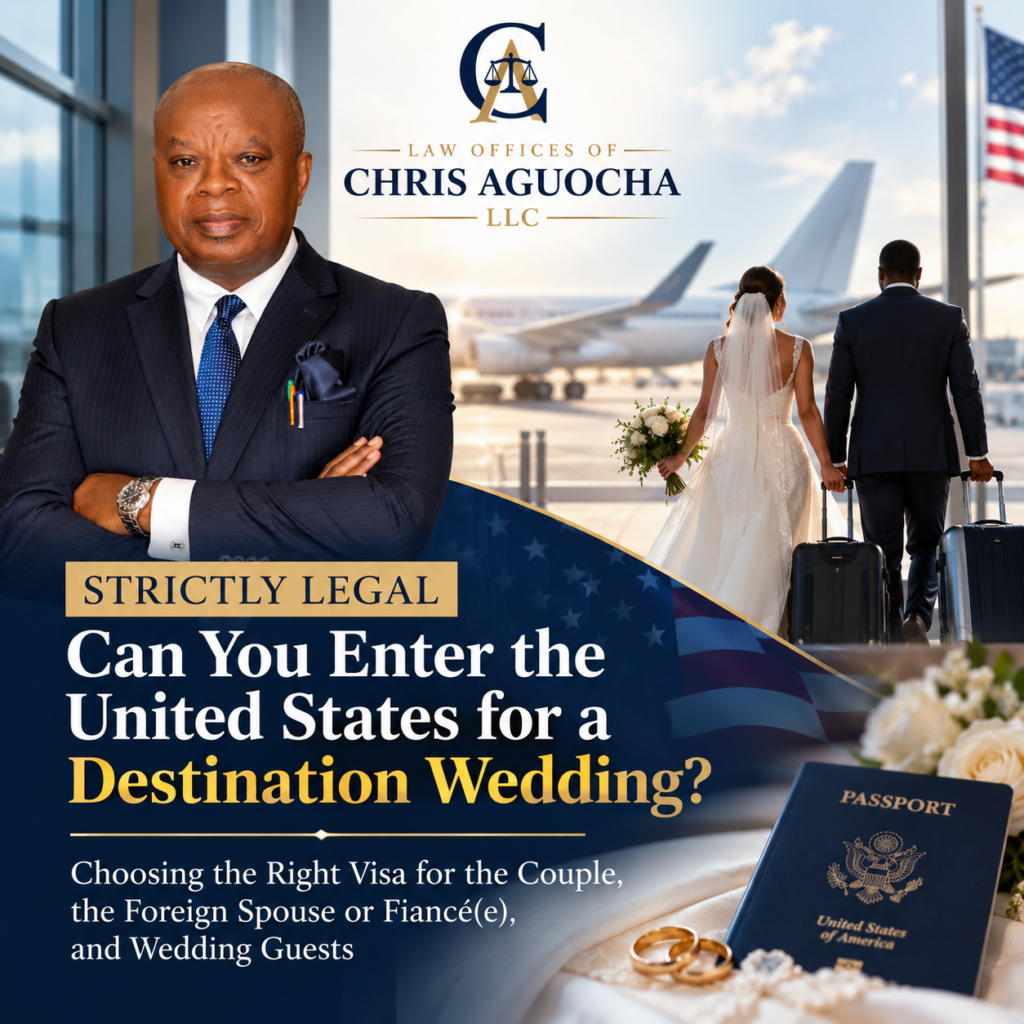

A destination wedding in the United States can be perfectly lawful.
But when the bride, groom, fiancé(e), spouse, or wedding guests are traveling from another country, the immigration analysis should begin before the airline tickets, venue deposits, and hotel reservations become nonrefundable.
There is no general “wedding visa.”
The appropriate immigration route depends on who is traveling, the person’s nationality and existing visa status, why the person is entering the United States, how long the person intends to remain, and—most importantly for the foreign partner—whether the plan is to leave after the wedding or remain permanently.
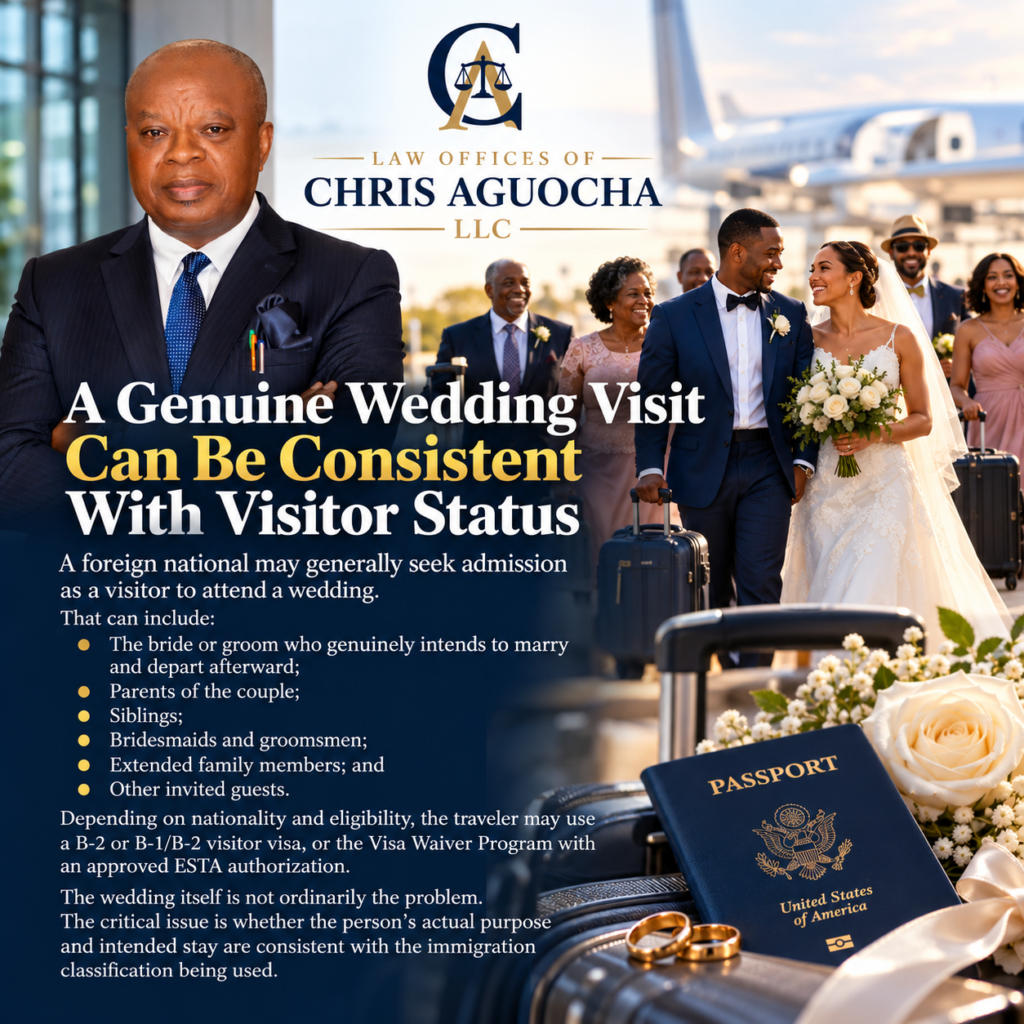
A Genuine Wedding Visit Can Be Consistent With Visitor Status
A foreign national may generally seek admission as a visitor to attend a wedding.
That can include:
• The bride or groom who genuinely intends to marry and depart afterward;
• Parents of the couple;
• Siblings;
• Bridesmaids and groomsmen;
• Extended family members; and
• Other invited guests.
Depending on nationality and eligibility, the traveler may use a B-2 or B-1/B-2 visitor visa, or the Visa Waiver Program with an approved ESTA authorization.
The wedding itself is not ordinarily the problem.
The critical issue is whether the person’s actual purpose and intended stay are consistent with the immigration classification being used.
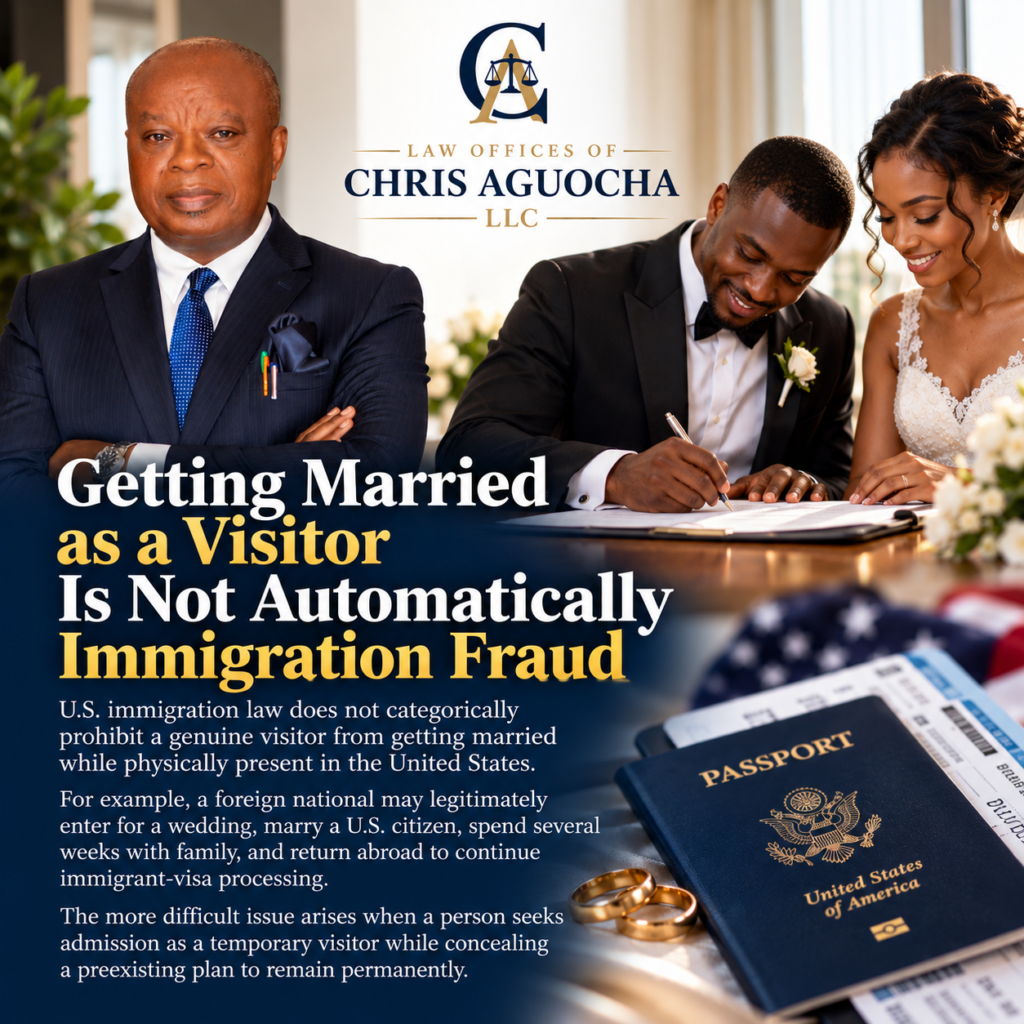
Getting Married as a Visitor Is Not Automatically Immigration Fraud
This distinction is important.
U.S. immigration law does not categorically prohibit a genuine visitor from getting married while physically present in the United States.
For example, a foreign national may legitimately enter for a wedding, marry a U.S. citizen, spend several weeks with family, and return abroad to continue immigrant-visa processing.
The more difficult issue arises when a person seeks admission as a temporary visitor while concealing a preexisting plan to remain permanently. BLOG POST SEPTEMBER 28 2026 – 2.pdf
Fraud or willful material misrepresentation under INA §212(a)(6)(C)(i) requires a legal analysis of the actual facts and representations.
Marriage after entry does not, standing alone, automatically prove that the traveler misrepresented his or her intentions at the port of entry.
The inquiry may include:
• What the traveler intended at entry;
• What the traveler told the consular officer;
• What was represented to CBP;
• Whether there was a preexisting immigration plan;
• Return travel arrangements;
• Employment or residence abroad;
• Prior immigration filings;
• Communications and other evidence concerning the travel plan; and
• What occurred after admission.
The correct question is not simply:
“Did you marry after entering as a visitor?”
It is:
“What was your actual intention, and what representations did you make when you sought the visa and admission?”
A Tourist Visa Should Not Be Used as a Concealed Immigrant Visa
A B-2/B-1/B-2 visa is for temporary travel.
If a foreign fiancé(e) has already formed the plan to enter the United States, marry the U.S. citizen partner, and remain permanently, attempting to accomplish that plan through visitor admission can create serious immigration problems.
The government may examine whether the traveler misrepresented a material fact concerning the purpose of the trip.
A finding under INA §212(a)(6)(C)(i) can have consequences extending far beyond the original wedding trip.
The better strategy is to identify the intended immigration outcome before selecting the visa category.
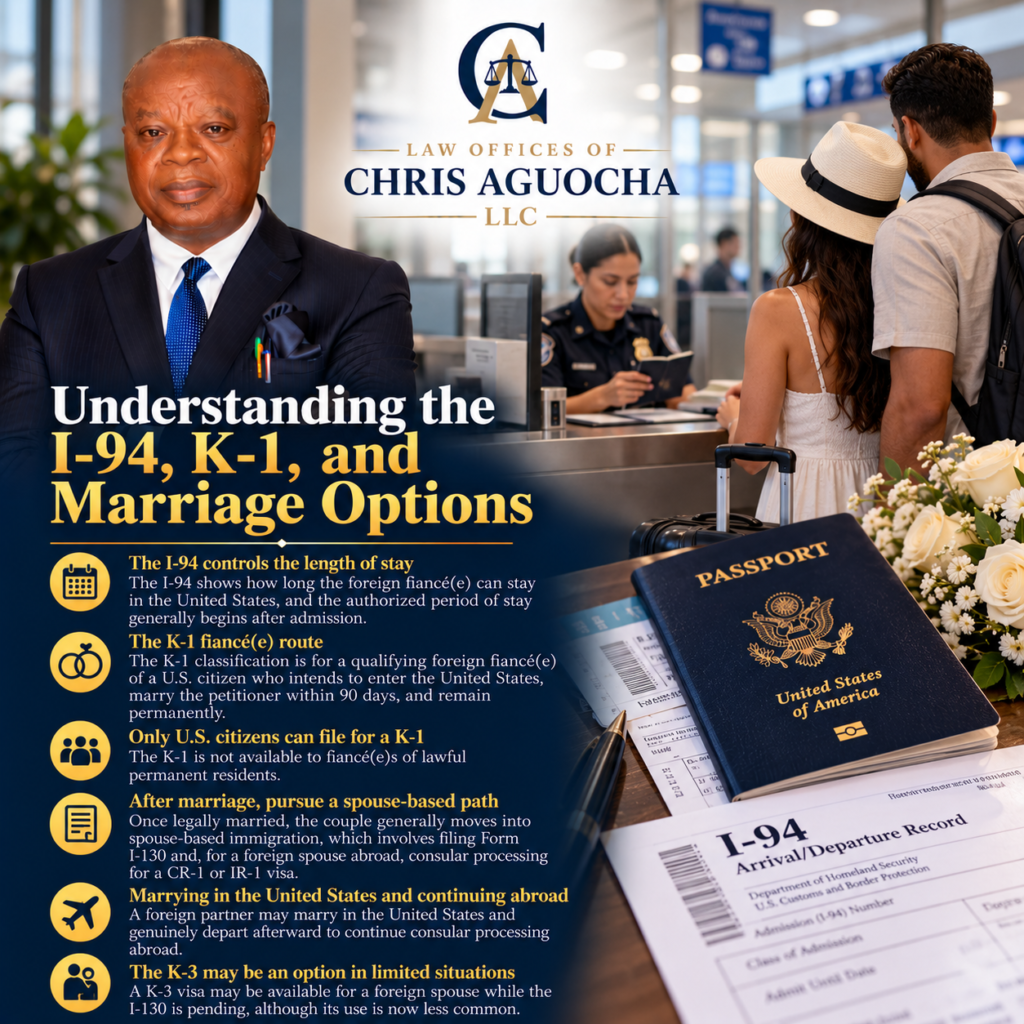
The I-94 Controls the Authorized Stay—not the Visa Expiration Date
Another common mistake is confusing the expiration date printed on the visa with the period the traveler is authorized to remain in the United States.
The visa generally permits the traveler to seek admission at a U.S. port of entry during its validity period.
CBP determines admission and the authorized period of stay.
For many travelers, that information is reflected in the electronic Form I-94 record.
A person whose visa remains valid for several years does not thereby have permission to remain in the United States for several years after a particular entry.
The I-94 should be checked after admission.
Staying Within the I-94 Period Does Not Resolve Every Intent Question
A visitor may technically remain within the authorized I-94 period and still create questions about whether the person’s conduct is consistent with the temporary purpose represented at entry.
For example, someone who represented that the trip was a short visit for a wedding but then rapidly takes steps consistent with a preexisting permanent relocation may face questions in a later immigration proceeding.
The fact that the I-94 had not yet expired does not necessarily answer whether a material misrepresentation occurred earlier.
Again, the analysis is highly fact-specific.
If the Fiancé(e) Plans to Enter, Marry, and Remain, Consider the K-1 Route
For a foreign fiancé(e) of a U.S. citizen who intends to enter the United States, marry the petitioner, and remain permanently, the K-1 fiancé(e) classification is specifically designed for that purpose.
The process generally begins with Form I-129F, Petition for Alien Fiancé(e).
After the petition and consular process are completed, the K-1 beneficiary may seek admission to the United States.
The couple must marry within 90 days of the K-1 beneficiary’s admission, and the marriage must be to the U.S. citizen petitioner.
The foreign spouse may then pursue adjustment of status to permanent residence.
K-1 Is for Fiancé(e)s of U.S. Citizens—not Green Card Holders
This distinction is important when planning the wedding.
The K-1 classification is available for qualifying fiancé(e)s of U.S. citizens.
A lawful permanent resident cannot file a K-1 petition for a fiancé(e).
If the U.S.-based partner is a Green Card holder, the couple may need to consider marriage followed by the appropriate family-sponsored immigrant process rather than K-1 processing.
That distinction should be identified before the wedding plan is built around a visa category that is unavailable.
Once the Couple Is Married, K-1 Is No Longer the Appropriate Classification
K-1 is a fiancé(e) classification.
Once the couple is legally married, the foreign national is no longer the U.S. citizen’s fiancé(e) for K-1 purposes.
A U.S. citizen or lawful permanent resident spouse generally begins the immigrant petition process by filing Form I-130, Petition for Alien Relative.
For a qualifying spouse processing abroad, the immigrant visa may ultimately be issued in the CR-1 or IR-1 category for a U.S. citizen’s spouse, depending on the duration of the marriage when permanent residence is obtained.
The specific classification and process depend on the petitioner’s status and the facts of the case.
A Couple Can Marry in the United States and Continue Consular Processing Abroad
A foreign national does not necessarily have to obtain a K-1 visa merely because the wedding ceremony will take place in the United States.
Consider a foreign partner who genuinely intends to:
- Enter temporarily for the wedding;
- Marry in the United States;
- Depart within the authorized period; and
- Complete immigrant-visa processing abroad.
That can present a different immigration situation from someone who intends before entry to marry and remain permanently.
Admission as a visitor is never guaranteed, however. The traveler must still establish eligibility for the requested temporary admission to the satisfaction of the relevant U.S. authorities.
What About the K-3 Visa?
The K-3 classification remains part of immigration law for certain foreign spouses of U.S. citizens.
But couples should not assume that K-3 will necessarily provide a faster practical route than ordinary spouse-based immigrant-visa processing.
Current processing practices can make the K-3 route of limited practical utility in many cases.
The case should therefore be evaluated based on current agency procedures rather than assuming that filing an I-129F after marriage will necessarily accelerate the spouse’s arrival.
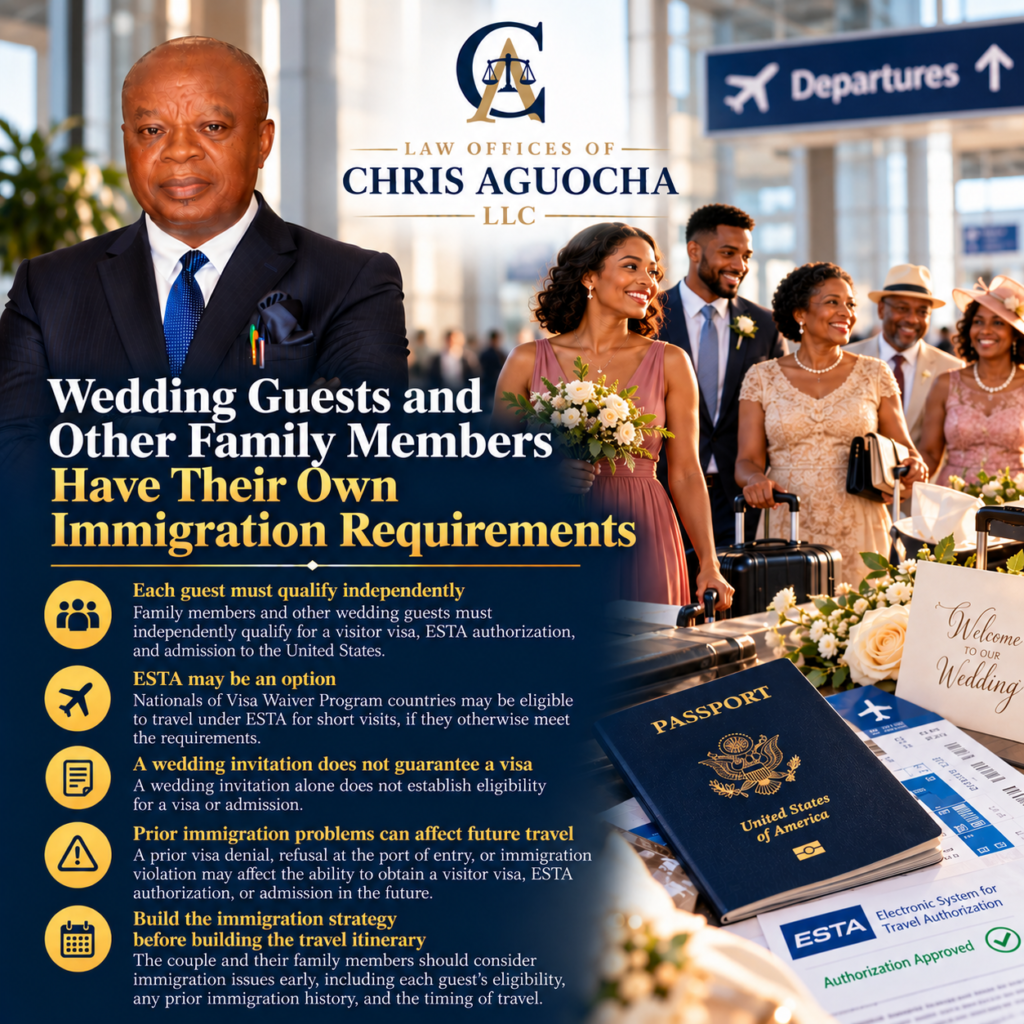
Wedding Guests Must Qualify Independently
A wedding invitation is useful evidence explaining why someone wants to visit the United States.
It is not a visa.
Each foreign guest must independently satisfy the requirements for the immigration mechanism being used.
A consular officer or CBP officer may consider matters including:
• Purpose of the trip;
• Length of proposed stay;
• Ability to pay for the trip;
• Employment;
• Family circumstances;
• Prior U.S. travel;
• Prior overstays;
• Immigration petitions;
• Prior visa refusals; and
• Reasons to return abroad.
A beautifully printed wedding invitation does not guarantee either visa issuance or admission.
ESTA Approval Does Not Guarantee Admission Either
Visa Waiver Program travelers should also distinguish between ESTA authorization and admission to the United States.
An approved ESTA permits an eligible traveler to seek travel under the Visa Waiver Program.
It does not guarantee admission.
CBP makes the admission determination at the port of entry.
VWP travel also carries legal consequences that differ in important respects from ordinary B-2 admission, particularly concerning extensions, changes of status, and the ability to contest removal.
A foreign fiancé(e) considering VWP travel for a U.S. wedding should therefore understand those differences before traveling.
Prior Immigration Problems Should Be Reviewed Before the Wedding Trip
Wedding planning can become substantially more complicated when the foreign partner or an important guest has a history involving:
• Prior visa refusals;
• Prior overstays;
• Unlawful presence;
• Removal or deportation;
• Expedited removal;
• Fraud or misrepresentation;
• Unauthorized employment;
• Criminal history; or
• Previous immigration petitions.
These issues should be identified before travel.
Buying a ticket or reserving a wedding venue does not cure inadmissibility.
Build the Immigration Strategy Before Building the Travel Itinerary
For an international couple planning a U.S. wedding, several questions should be answered early:
• Is the foreign partner currently a fiancé(e) or already a spouse?
• Is the U.S. partner a citizen or lawful permanent resident?
• Will the foreign partner leave the United States after the ceremony?
• Is permanent relocation already planned?
• Is K-1 legally available?
• Would marriage followed by CR-1/IR-1 or other spouse-based processing be more appropriate?
• Does the foreign partner already possess a visitor visa?
• Is the person eligible for the Visa Waiver Program?
• Are there prior immigration violations?
• Are there inadmissibility concerns?
• Will key family members require visas?
• How much flexibility exists if a visa is delayed or refused?
The immigration strategy should ideally be determined before nonrefundable wedding commitments depend on a particular person’s ability to enter the United States.
Key Takeaways
• There is no special U.S. “destination wedding visa.”
• A genuine temporary trip to attend or participate in a wedding may be consistent with B-2/B-1/B-2 visitor status or the Visa Waiver Program when the traveler is otherwise eligible.
• Getting married while visiting the United States is not automatically immigration fraud.
• The critical issue is whether the traveler truthfully represented the purpose and temporary nature of the trip when seeking the visa and admission.
• A visitor visa should not be used as a concealed substitute for a planned permanent immigration process.
• The I-94—not the visa expiration date—generally controls the authorized period of stay after admission.
• A K-1 visa is designed for a qualifying foreign fiancé(e) of a U.S. citizen who intends to enter, marry the petitioner within 90 days, and pursue permanent residence.
• K-1 is not available to fiancé(e)s of lawful permanent residents.
• Once legally married, the couple generally moves into spouse-based immigration rather than K-1 processing.
• A foreign partner may marry in the United States and genuinely depart afterward to continue consular processing abroad.
• Wedding guests must independently qualify for their visas, ESTA authorization, and admission.
• A wedding invitation does not guarantee a visa or admission to the United States.
Planning a Destination Wedding in the United States?
If the bride, groom, fiancé(e), spouse, parents, or other key family members will be traveling from abroad, immigration planning should occur before the wedding itinerary becomes fixed.
Our office can review visitor visa eligibility, K-1 versus spouse-based processing, the intended length of stay, prior immigration history, possible inadmissibility or misrepresentation issues, and the appropriate strategy for the couple and traveling family members.
Contact Law Offices of Chris Aguocha LLC
Office: 301-322-1304
Cell: 240-470-4364
Email: chris@aguochalawyer.com
Disclaimer: This article is provided for general informational purposes only and does not constitute legal advice. Reading this article does not create an attorney-client relationship. Visa eligibility, admission, immigrant intent, fraud or misrepresentation, K-1 eligibility, adjustment of status, consular processing, and Visa Waiver Program issues depend on the particular facts and current immigration law and agency procedures.
