
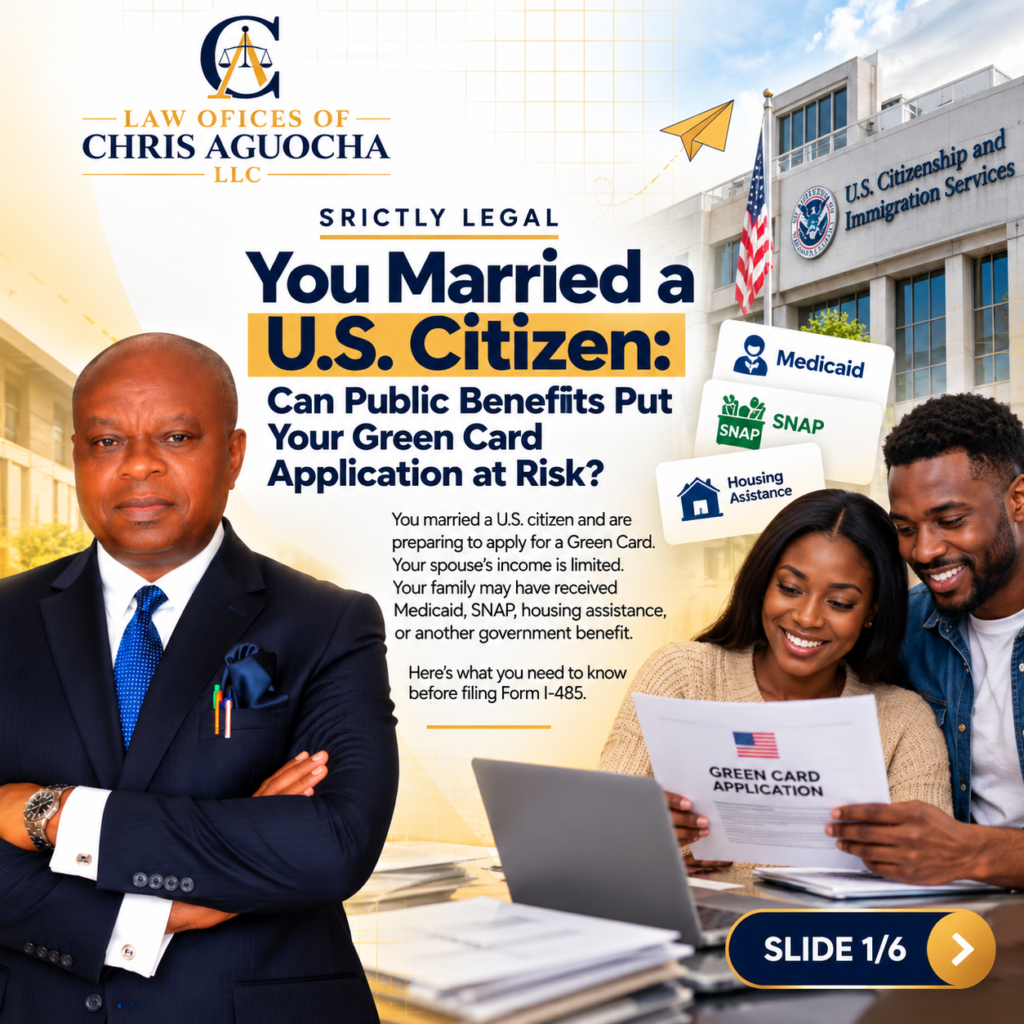
You married a U.S. citizen and are preparing to apply for a Green Card.
Your spouse’s income is limited. Your family may have received Medicaid, SNAP food assistance, housing assistance, or another government benefit.
Now you are worried:
Could receiving public benefits cause USCIS to deny your marriage-based Green Card application?
The answer depends on the applicable immigration rules, who received the benefits, when they were received, and the household’s overall financial circumstances.
Marriage to a U.S. citizen creates a potential immigration pathway, but it does not automatically eliminate public-charge inadmissibility. Conversely, receiving government assistance does not automatically mean that a Green Card application must be denied.
Significant changes to the public-charge framework took effect on September 18, 2026.
Applicants should understand those changes before filing, withdrawing, or refiling Form I-485.
Marriage Does Not Automatically Satisfy Every Green Card Requirement
A U.S. citizen may generally file Form I-130, Petition for Alien Relative, for a qualifying foreign spouse.
An approved I-130 establishes the qualifying family relationship for immigration petition purposes.
But it does not independently establish that the foreign spouse satisfies every requirement for permanent residence.
A marriage-based applicant may still need to establish:
- Eligibility for adjustment of status;
- Inspection and admission or parole, where required;
- Admissibility;
- A legally valid marriage;
- A bona fide marital relationship;
- Financial sponsorship; and
- Eligibility under the applicable public-charge rules.
These requirements should be evaluated separately.
What Is the Public-Charge Ground of Inadmissibility?
Under INA §212(a)(4), certain applicants may be found inadmissible if they are determined likely at any time to become a public charge.
This is generally a prospective assessment.
USCIS examines the applicant’s circumstances and the available evidence to evaluate the likelihood of future reliance on government support.
The statute identifies five principal factors:
- Age;
- Health;
- Family status;
- Assets, resources, and financial status; and
- Education and skills.
Where applicable, the agency also considers the required affidavit of support.
No applicant should assume that a single episode of financial hardship automatically determines the entire case.
The Rules Changed on September 18, 2026
On July 20, 2026, DHS published a final rule rescinding the 2022 public-charge regulations.
The new rule took effect on September 18, 2026.
USCIS also issued revised Policy Manual guidance governing public-charge determinations.
The updated framework allows officers to consider a broader range of relevant financial circumstances and means-tested public benefits.
This is particularly important for marriage-based adjustment applicants whose households have received government assistance.
Filing Dates and Benefit Dates Are Two Different Questions
The effective date creates two separate timing issues.
First: When was the adjustment application filed?
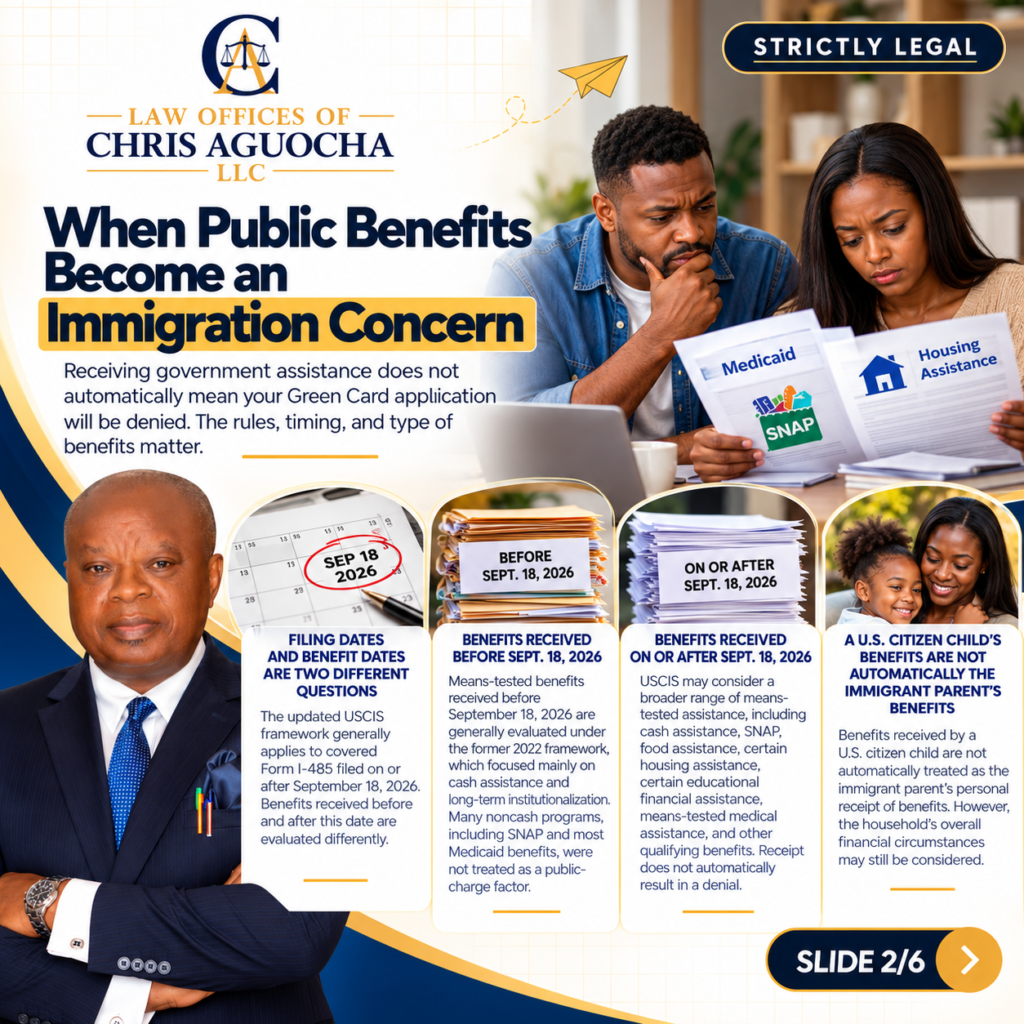
The updated USCIS framework generally applies to covered Forms I-485 postmarked or electronically submitted on or after September 18, 2026.
A properly filed earlier application generally remains subject to the framework applicable to that filing.
However, rejection, withdrawal, or refiling may create a different filing date and require a fresh analysis.
Second: When did the applicant receive the benefits?
The new rule treats benefits received before September 18, 2026 differently from benefits received on or after that date.
These two questions should not be confused.
Benefits Received Before September 18, 2026
Under the transition provisions, means-tested public benefits received before September 18, 2026 are evaluated consistently with the former 2022 framework.
That framework generally focused on:
- Public cash assistance for income maintenance; and
- Long-term institutionalization at government expense.
It did not treat ordinary receipt of many noncash programs, including SNAP and most Medicaid benefits, as a public-charge factor.
Accordingly, applicants should not assume that every benefit received before September 18 is now retroactively treated in the same way as benefits received afterward.
The precise program and circumstances still matter.
Benefits Received on or After September 18, 2026
The updated framework is broader.
USCIS may consider means-tested assistance such as:
- Cash assistance for income maintenance;
- SNAP or food assistance;
- Certain housing assistance;
- Certain educational financial assistance;
- Means-tested medical assistance; and
- Other qualifying means-tested benefits.
The analysis is not limited to whether the applicant received cash.
USCIS may also examine relevant applications for benefits, approvals or certifications, and actual receipt, according to the governing requirements.
But an application for assistance, approval of assistance, and actual payment or receipt are different events.
Their dates and circumstances should be documented accurately.
The existence of a means-tested benefit does not automatically establish that the applicant is inadmissible.
USCIS must still apply the governing public-charge analysis to the individual case.
Benefits Received by a U.S. Citizen Child Are Not Automatically the Immigrant Parent’s Benefits
Consider a common family situation.
A U.S. citizen husband petitions for his foreign-born wife.
The couple has a U.S. citizen child who receives Medicaid or SNAP.
Does the child’s assistance automatically count as the immigrant mother’s receipt of benefits?
No. The identity of the actual recipient matters.
A benefit received by a U.S. citizen child should not simply be attributed to the immigrant parent as though the parent personally received it.
However, the household’s broader financial circumstances may still be relevant to the prospective assessment.
Counsel should identify:
- The program;
- The person legally receiving the benefit;
- The coverage period;
- Whether the applicant was a beneficiary;
- Whether the benefit was means-tested; and
- How the program relates to the household’s financial circumstances.
This distinction is particularly important in mixed-status families.
What If the Applicant Has a Medical Condition?
An applicant may have a chronic illness, disability, pregnancy-related medical needs, or other health concerns.
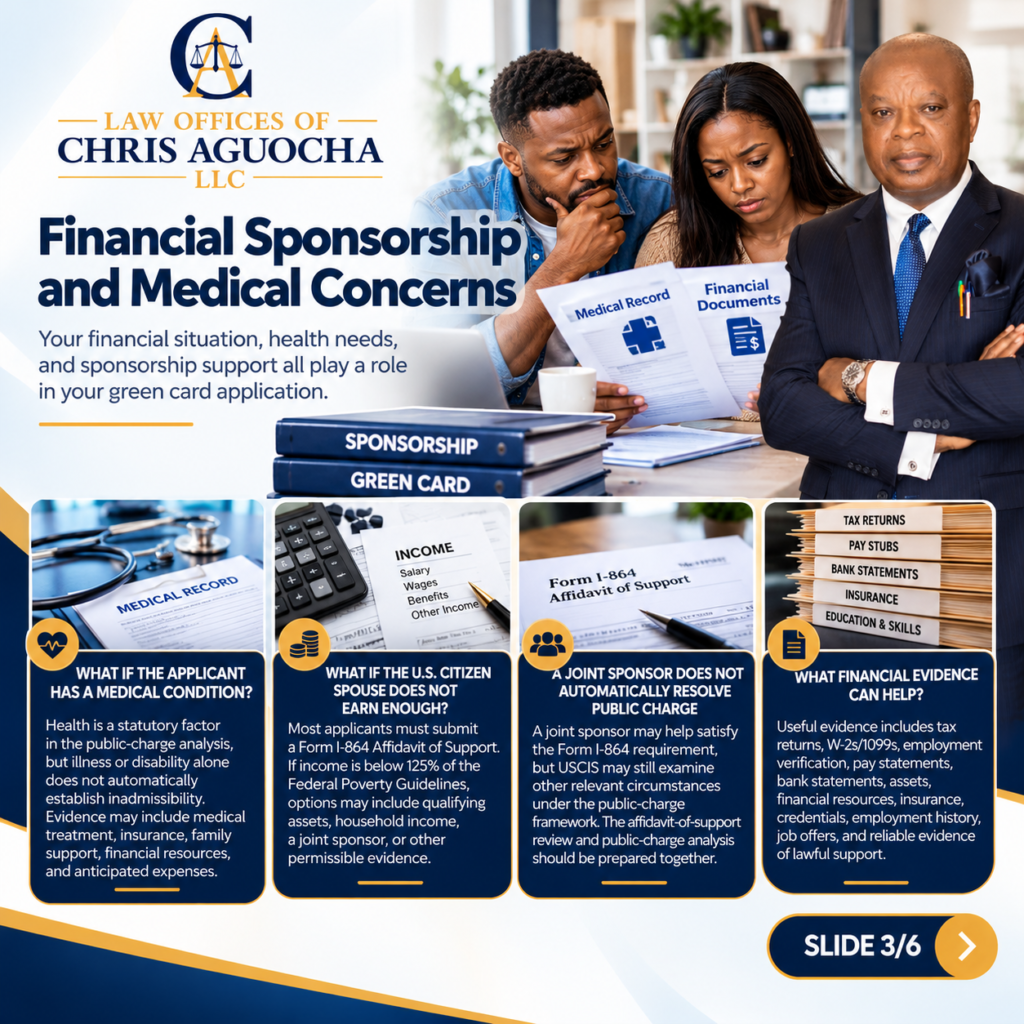
Health is a statutory factor in the public-charge analysis.
But illness or disability alone does not automatically establish public-charge inadmissibility.
Relevant evidence may include:
- Medical treatment arrangements;
- Health insurance;
- Available family support;
- Financial resources;
- Ability to meet anticipated medical expenses; and
- Other circumstances bearing on future support.
Applicants should not assume that discontinuing necessary medical care will improve their immigration case.
The better approach is to identify the applicable rules and document the actual circumstances.
What If the U.S. Citizen Spouse Does Not Earn Enough?
Most ordinary marriage-based applicants must submit a qualifying Form I-864, Affidavit of Support, signed by the petitioning spouse.
The sponsor generally must demonstrate sufficient financial ability under the applicable household-size and income requirements.
For many sponsors, the relevant threshold is 125% of the Federal Poverty Guidelines, although specific exceptions apply.
A spouse whose income falls below the applicable threshold may still have options.
Depending on the circumstances, these may include:
- Qualifying assets;
- Eligible household-member income;
- A qualifying joint sponsor; or
- Other permissible evidence under the affidavit-of-support rules.
The appropriate solution depends on the financial documentation and the household’s actual circumstances.
A Joint Sponsor Does Not Automatically Resolve Public Charge
A qualifying joint sponsor may help satisfy the Form I-864 financial sponsorship requirement.
But an adequate affidavit of support does not automatically guarantee that USCIS will find the applicant admissible under every applicable public-charge consideration.
The agency may still examine other relevant circumstances under the governing framework.
This is why the affidavit-of-support review and the broader public-charge assessment should be prepared together, without treating them as legally identical.
What Financial Evidence Can Help?
Depending on the case, useful evidence may include:
- Recent federal tax returns;
- W-2s and 1099s;
- Employment verification;
- Recent pay statements;
- Bank statements;
- Documented assets;
- Proof of accessible financial resources;
- Health insurance;
- Professional qualifications;
- Educational credentials;
- Employment history;
- Job offers where relevant; and
- Reliable evidence of lawful financial support.
Temporary unemployment or a period of financial hardship should be explained accurately rather than concealed.
The objective is to present a complete and supportable financial picture.
Form I-864 Creates Separate Legal Obligations
The affidavit of support is not merely a document showing that the sponsor has adequate income on the filing date.
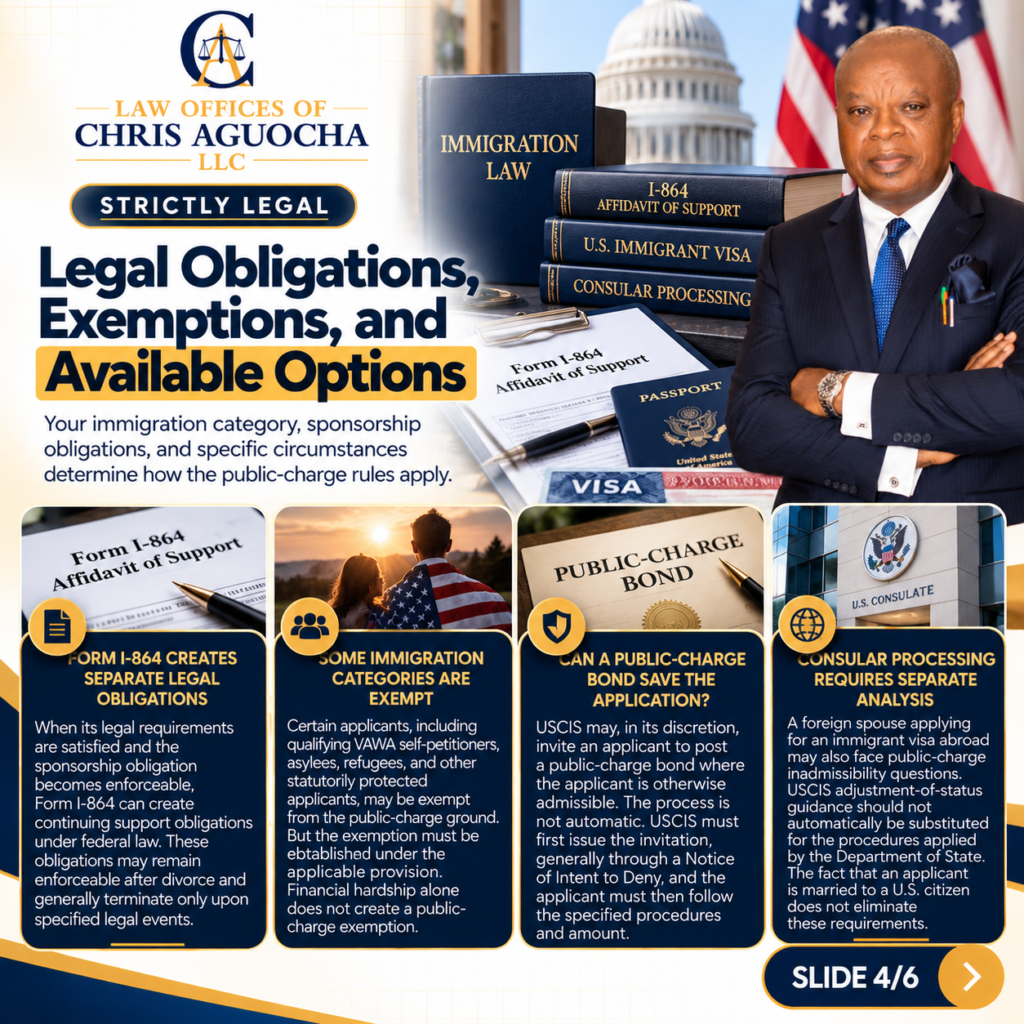
When its legal requirements are satisfied and the sponsorship obligation becomes enforceable, Form I-864 can create continuing support obligations under federal law.
Those obligations may remain enforceable after divorce and generally terminate only upon specified legal events.
In certain circumstances, government agencies may also seek reimbursement of designated means-tested public benefits from a sponsor.
That reimbursement question is separate from whether the immigrant applicant is inadmissible as likely to become a public charge.
A public-charge finding, an affidavit-of-support obligation, and a benefit-reimbursement claim should therefore not be treated as the same legal issue.
Some Immigration Categories Are Exempt
Not every applicant for permanent residence is subject to the public-charge ground.
Federal law provides exemptions for certain protected categories, including qualifying applicants under specified humanitarian provisions.
Depending on the particular immigration pathway, exemptions may apply to certain VAWA self-petitioners, asylees, refugees, and other statutorily protected applicants.
But the exemption must be established under the applicable provision.
Financial hardship alone does not create a public-charge exemption.
Likewise, merely alleging abuse does not automatically establish eligibility for a protected immigration classification.
Can a Public-Charge Bond Save the Application?
The updated USCIS framework provides a mechanism for public-charge bonds in qualifying cases.
Where an applicant is otherwise admissible but USCIS determines that public charge is the remaining inadmissibility issue, USCIS may, in its discretion, invite the applicant to post a bond.
The process is not automatic.
The applicant cannot simply submit a bond with Form I-485 and demand approval.
USCIS must first issue the applicable invitation, generally through a Notice of Intent to Deny.
If invited, the applicant must comply with the specified bond procedures, amount, and instructions.
The availability of a bond should therefore be treated as a potential discretionary mechanism—not a guaranteed solution.
Consular Processing Requires Separate Analysis
A foreign spouse applying for an immigrant visa abroad may also face public-charge inadmissibility questions.
But USCIS adjustment-of-status guidance should not automatically be substituted for the procedures applied by the Department of State.
Consular cases require review of the applicable statutory requirements, State Department guidance, financial sponsorship, and any relevant consular instructions.
The fact that an applicant is married to a U.S. citizen does not eliminate those requirements.
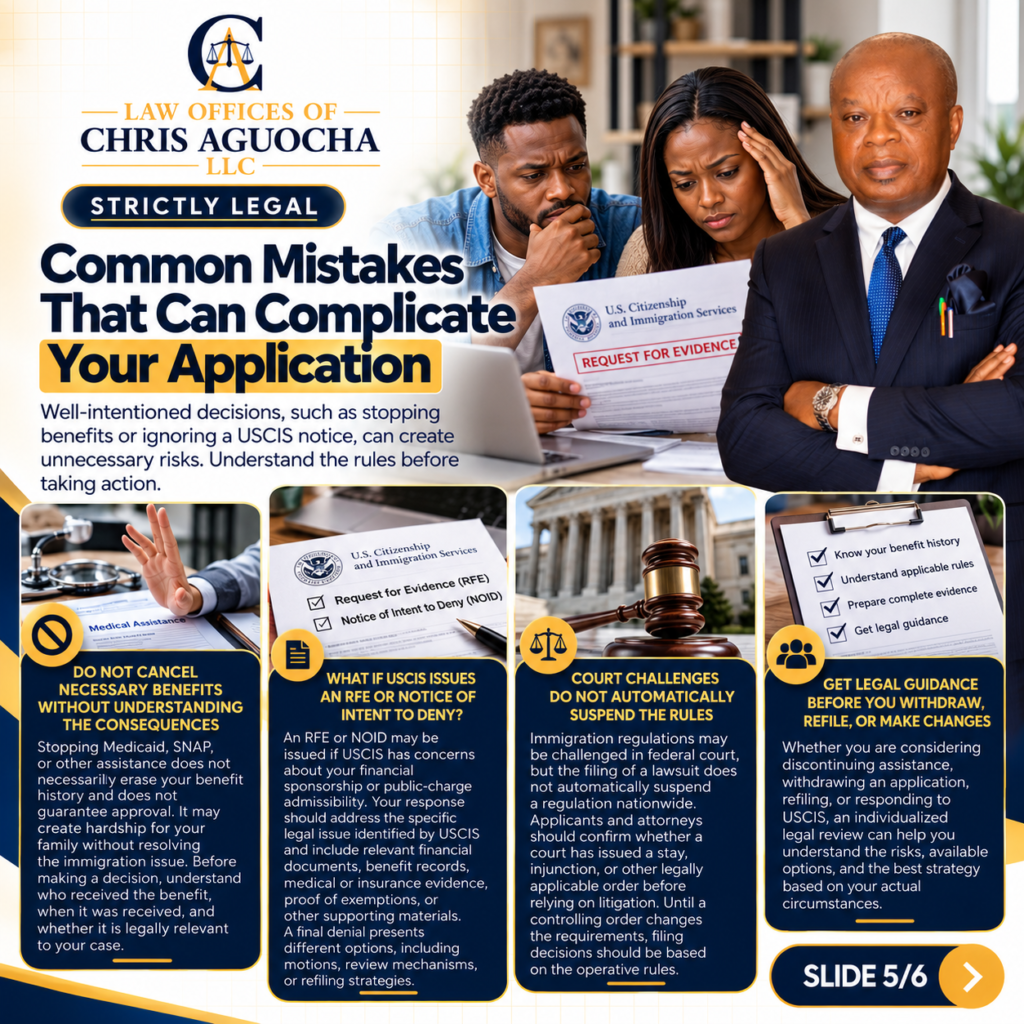
Do Not Cancel Necessary Benefits Without Understanding the Consequences
Some families respond to public-charge concerns by immediately discontinuing medical or food assistance.
That decision may create hardship without resolving the immigration issue.
Stopping assistance today does not necessarily erase the applicant’s benefit history.
It also does not guarantee approval.
Before making a decision, families should determine:
- Who actually received the benefit;
- Whether the applicant’s receipt is legally relevant;
- When the benefit was received;
- Whether the applicant is exempt;
- Whether the application is governed by the earlier or current framework; and
- What evidence is needed to explain the circumstances.
The immigration consequences and the family’s immediate welfare should both be understood.
What If USCIS Issues an RFE or Notice of Intent to Deny?
An applicant may receive a Request for Evidence (RFE) or Notice of Intent to Deny (NOID) concerning financial sponsorship or public-charge inadmissibility.
The response should address the actual legal deficiency identified by USCIS.
For example, an insufficient Form I-864 may require different evidence from a concern involving receipt of means-tested benefits.
A response may need to include financial documents, benefit records, medical or insurance evidence, proof of exemptions, or other supporting materials.
A final denial presents different procedural questions from an RFE or NOID.
Available motions, review mechanisms, or refiling strategies should be evaluated individually.
Court Challenges Do Not Automatically Suspend the Rules
Immigration regulations may be challenged in federal court.
But the filing of a lawsuit does not automatically suspend a regulation nationwide.
Applicants and attorneys should verify whether an actual stay, injunction, or other controlling judicial order applies before relying on litigation.
Until a legally applicable order changes the requirements, filing decisions should be based on the operative rules.
Key Takeaways
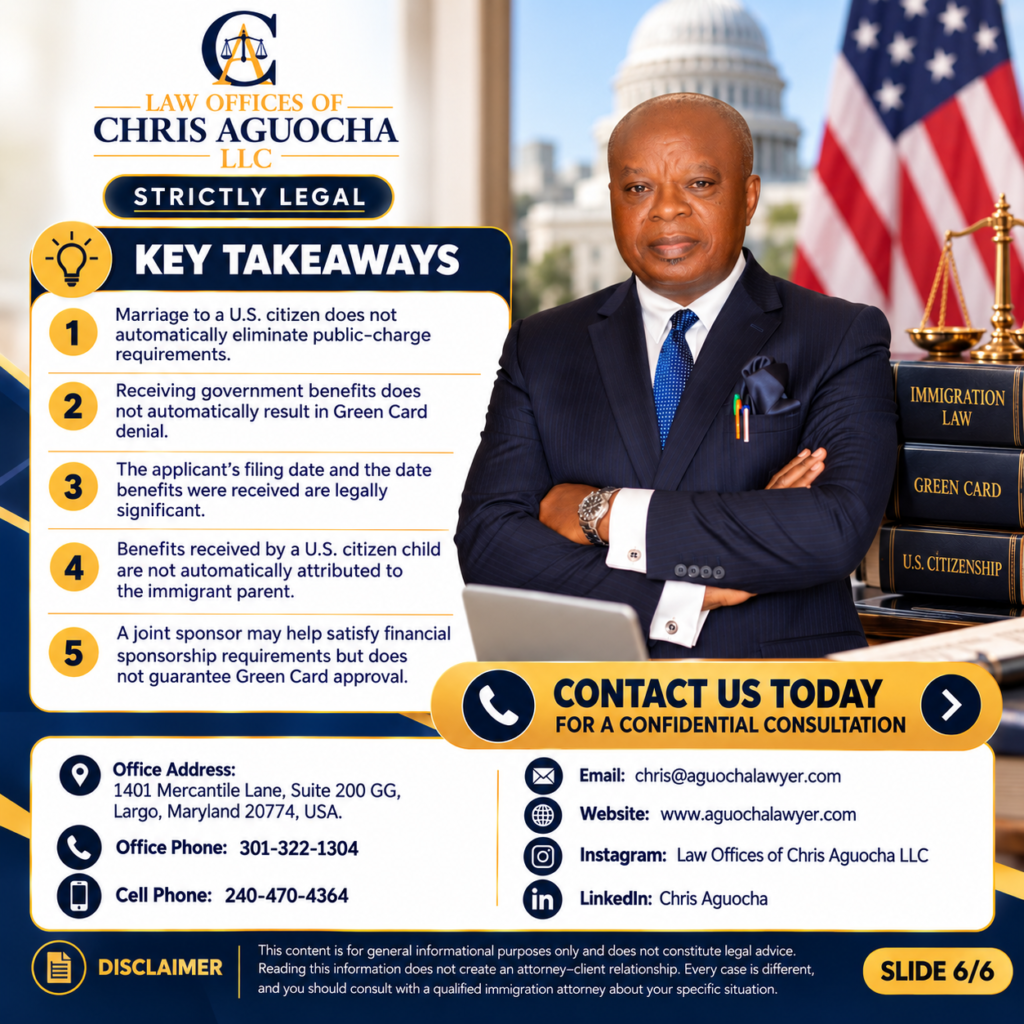
- Marriage to a U.S. citizen does not automatically eliminate public-charge requirements.
- An approved Form I-130 does not establish every requirement for permanent residence.
- The revised public-charge framework became effective September 18, 2026.
- The filing date of Form I-485 and the date of benefit receipt raise different legal questions.
- Benefits received before September 18, 2026 receive different transitional treatment from benefits received afterward.
- Receipt of means-tested assistance does not automatically establish inadmissibility.
- A U.S. citizen child’s benefits are not automatically the immigrant parent’s personal receipt of benefits.
- Health concerns, temporary hardship, and limited income require individualized review.
- A joint sponsor may satisfy affidavit-of-support requirements without guaranteeing a favorable public-charge determination.
- Form I-864 support obligations and government reimbursement claims are legally separate from public-charge inadmissibility.
- Certain humanitarian applicants are exempt, but eligibility must be established.
- Public-charge bonds are discretionary and generally require an invitation from USCIS.
- Applicants should obtain legal advice before discontinuing assistance, responding to USCIS, withdrawing, or refiling.
Concerned That Public Benefits Could Affect Your Marriage-Based Green Card?
If you are married to a U.S. citizen and are concerned about Medicaid, SNAP, housing assistance, limited sponsor income, medical expenses, or a USCIS public-charge inquiry, an individualized review can help clarify the applicable requirements.
Our office can examine your filing history, household financial records, benefit recipients, benefit dates, Form I-864 sponsorship, eligibility for exemptions, and USCIS correspondence to develop a strategy supported by your actual circumstances.
Law Offices of Chris Aguocha LLC
Office: 301-322-1304
Cell: 240-470-4364
Email: chris@aguochalawyer.com
Disclaimer: This article is provided for general educational purposes only and does not constitute legal advice.
