
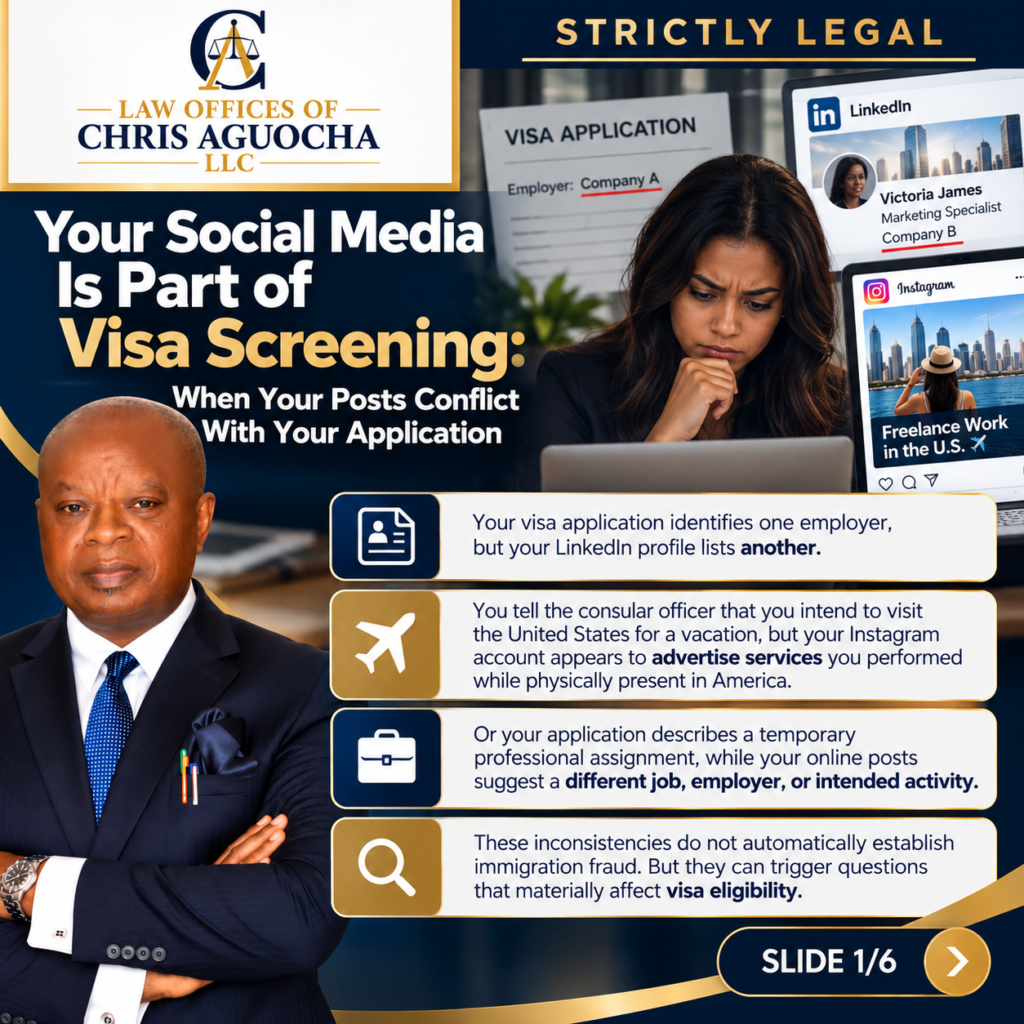
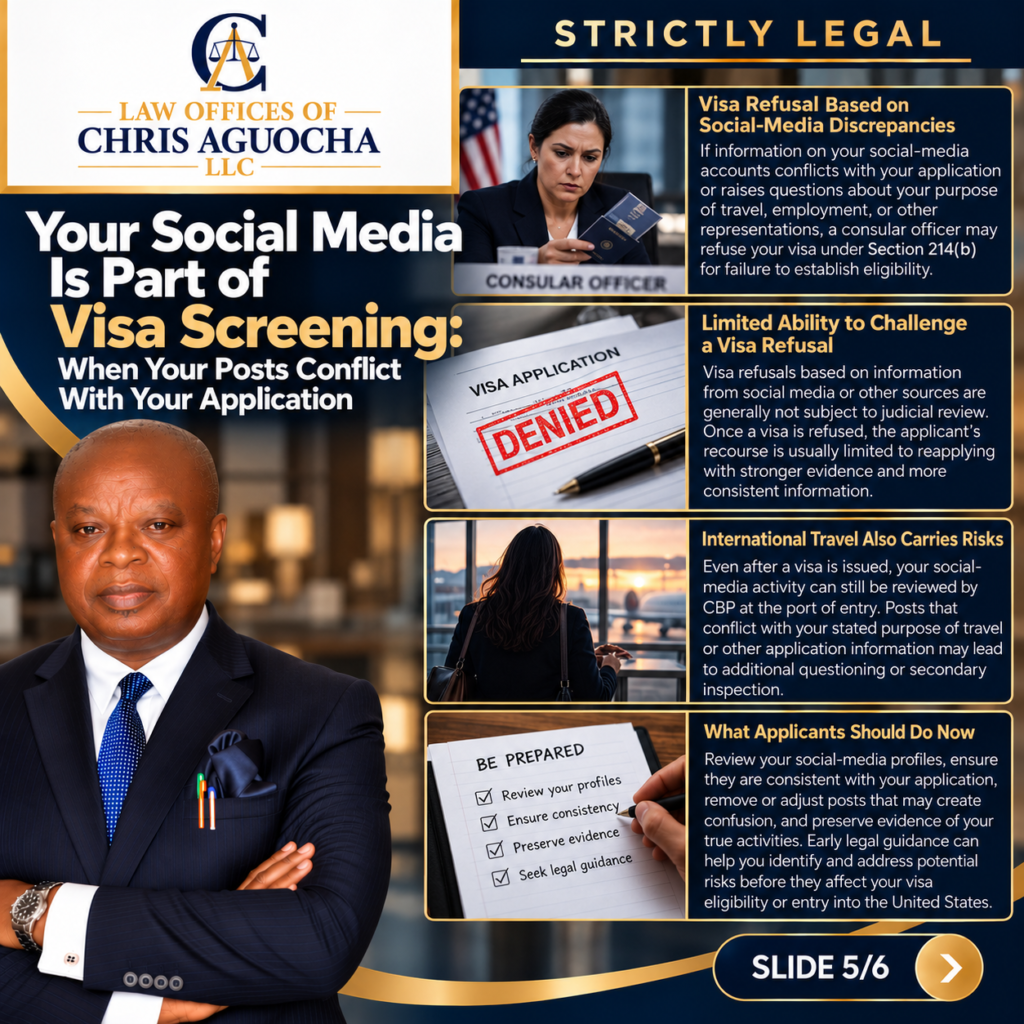

Your visa application identifies one employer, but your LinkedIn profile lists another.
You tell the consular officer that you intend to visit the United States for a vacation, but your Instagram account appears to advertise services you performed while physically present in America.
Or your application describes a temporary professional assignment, while your online posts suggest a different job, employer, or intended activity.
These inconsistencies do not automatically establish immigration fraud. But they can trigger questions that materially affect visa eligibility.
As the United States expands online-presence screening for additional visa categories, applicants should understand the difference between an innocent discrepancy, an actual immigration violation, and a willful material misrepresentation.
Expanded Social-Media Screening Now Covers Additional Visa Categories
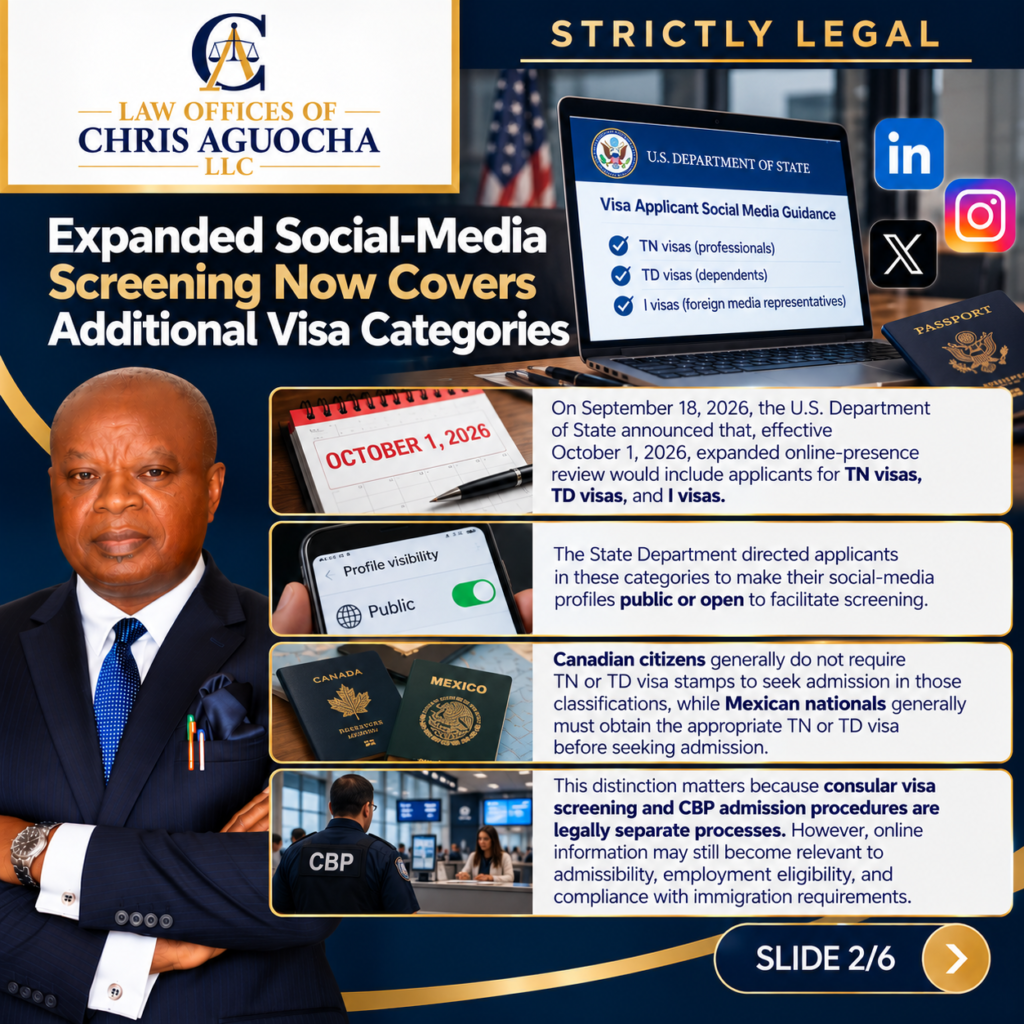
On September 18, 2026, the U.S. Department of State announced that, effective October 1, 2026, expanded online-presence review would include applicants for:
- TN visas: Qualifying professionals under the United States–Mexico–Canada Agreement.
- TD visas: Qualifying dependents of TN professionals.
- I visas: Representatives of foreign information media.
The State Department directed applicants in these categories to make their social-media profiles public or open to facilitate screening.
These categories join others already subject to expanded online-presence review, including F-1 students, J-1 exchange visitors, certain temporary workers, and qualifying dependents.
However, not every visa category or immigration process is governed by identical screening instructions.
Applicants should follow the requirements applicable to their particular classification.
Canadian TN and TD Applicants Require a Separate Distinction
Canadian citizens generally do not require TN or TD visa stamps to seek admission in those classifications.
Their eligibility may instead be examined by CBP at a port of entry.
Mexican nationals generally must obtain the appropriate TN or TD visa before seeking admission.
This distinction matters because consular visa screening and CBP admission procedures are legally separate processes.
A policy directed at applicants for consular visas should not automatically be described as applying in precisely the same manner to every visa-exempt Canadian national seeking admission.
Nevertheless, online information may still become relevant to admissibility, employment eligibility, and compliance with immigration requirements.
A Social-Media Discrepancy Is Not Automatically Fraud
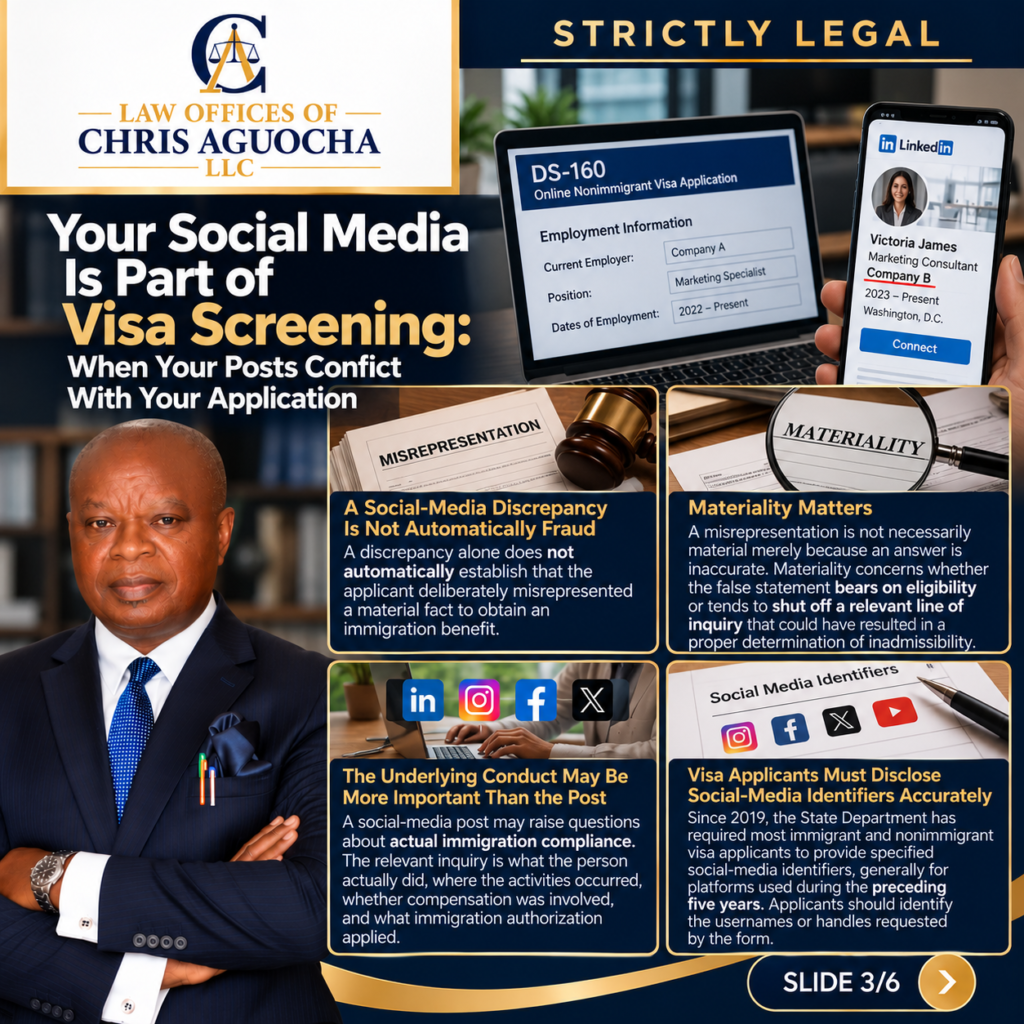
Consider an applicant whose DS-160 identifies employment with Company A, while LinkedIn lists Company B.
There may be several explanations.
The applicant may have changed employers after submitting the form.
The LinkedIn profile may be outdated.
The person may have worked for a subsidiary, parent company, or contracting organization.
Or the application may contain an actual error.
These possibilities require factual investigation.
Under INA §212(a)(6)(C)(i), a finding of inadmissibility for fraud or willful material misrepresentation requires satisfaction of the applicable legal elements.
A discrepancy alone does not automatically establish that the applicant deliberately misrepresented a material fact to obtain an immigration benefit.
Materiality Matters
A misrepresentation is not necessarily material merely because an answer is inaccurate.
Materiality generally concerns whether the false statement bears on eligibility or tends to shut off a relevant line of inquiry that could have resulted in a proper determination of inadmissibility.
For example, an inaccurate employment history may become material if it conceals unauthorized employment, misstates qualifying professional experience, or prevents meaningful examination of the applicant’s intended activities.
An outdated profile description may present a different legal question.
Counsel should therefore examine:
- The original application question;
- The answer provided;
- The actual facts;
- The applicant’s knowledge;
- The timing of the discrepancy;
- Whether the statement was willful; and
- Whether the information was material to visa eligibility.
A qualifying finding under INA §212(a)(6)(C)(i) can result in permanent inadmissibility unless an applicable waiver or other legal remedy is available.
The Underlying Conduct May Be More Important Than the Post
A social-media post may raise questions about actual immigration compliance.
For example:
TN professionals: A profile may describe duties that differ from the professional occupation or employment arrangement supporting TN classification.
TD dependents: A post may suggest that the dependent is performing compensated services. TD status itself does not authorize employment.
Foreign media representatives: A project may appear to involve commercial entertainment or production activities rather than qualifying foreign-media work.
F-1 students: Sponsored posts, consulting activities, or other compensated services may raise questions about whether the student engaged in employment requiring authorization.
These are examples of potential issues—not automatic violations.
The relevant inquiry is what the person actually did, where the activities occurred, whether compensation was involved, and what immigration authorization applied.
Changing a caption does not cure unauthorized employment if unauthorized employment actually occurred.
Visa Applicants Must Disclose Social-Media Identifiers Accurately
Since 2019, the State Department has required most immigrant and nonimmigrant visa applicants to provide specified social-media identifiers.
The relevant forms generally request information about listed platforms used during the preceding five years.
Applicants should identify the usernames or handles requested by the form, including multiple accounts where the instructions require them.
The five-year disclosure period should not be interpreted as a guarantee that older publicly accessible information will never be considered.
Applicants who have not used the listed platforms should respond truthfully according to the form instructions.
They should not invent accounts or provide inaccurate identifiers.
The Government’s Published Identifier Requirements Do Not Ask for Passwords
The State Department’s published social-media identifier guidance distinguishes usernames and handles from account passwords.
Applicants are not instructed to supply their social-media passwords as part of the standard identifier-collection questions.
That distinction should not be confused with the separate requirement that applicants in designated visa categories make their profiles public or open for expanded review.
Applicants should follow official instructions and remain alert to fraudulent requests for credentials.
What If the DS-160 Has Already Been Submitted?
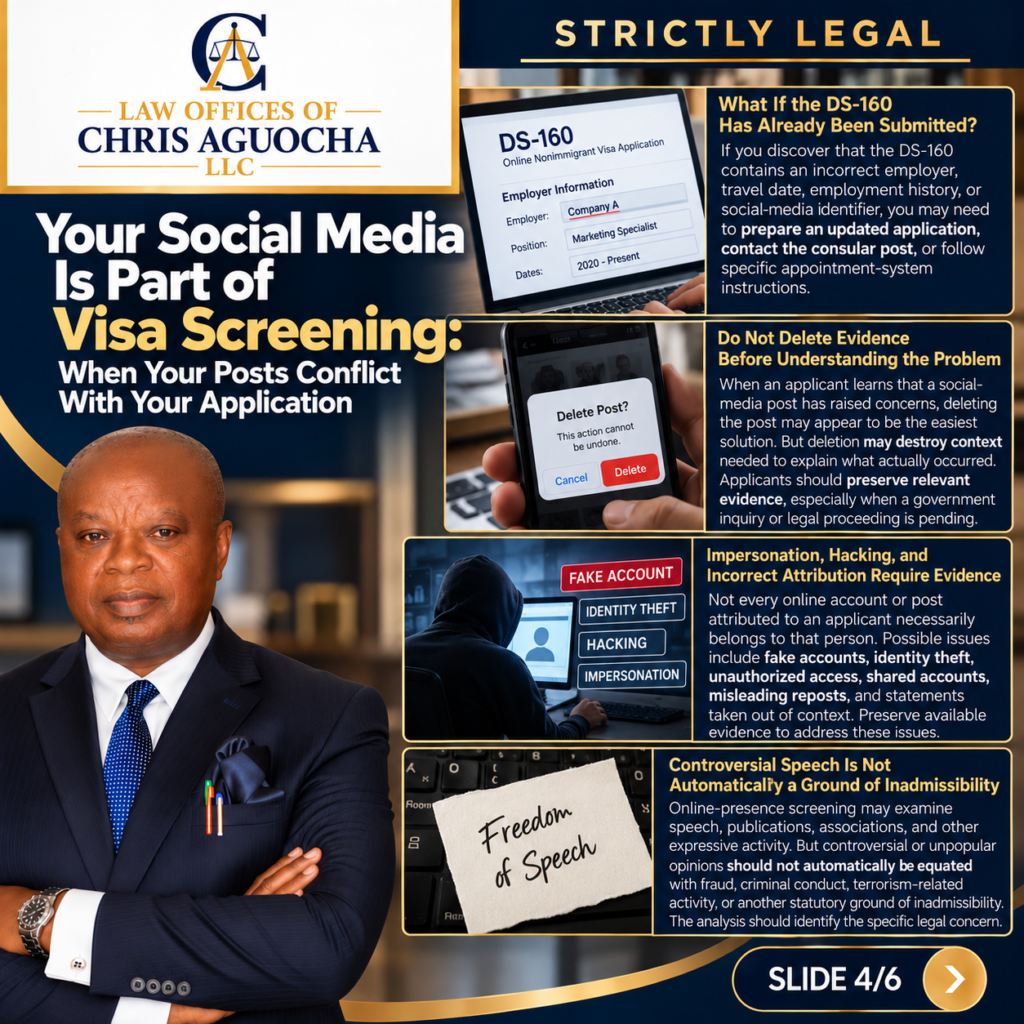
Suppose an applicant discovers that the DS-160 contains an incorrect employer, travel date, employment history, or social-media identifier.
The appropriate response depends on the nature of the error and the stage of processing.
A correction may require preparing an updated application, contacting the consular post, or following specific appointment-system instructions.
Submitting another DS-160 does not necessarily update an existing appointment automatically.
Applicants should preserve the original submission and follow the relevant embassy or consulate’s instructions.
Correcting an error is important, but it does not automatically erase the legal consequences of an earlier willful material misrepresentation.
Where a timely-retraction argument may be relevant, the timing, voluntariness, and circumstances of the correction require separate legal analysis.
Do Not Delete Evidence Before Understanding the Problem
When an applicant learns that a social-media post has raised concerns, deleting the post may appear to be the easiest solution.
But deletion may destroy context needed to explain what actually occurred.
Before making changes, applicants should preserve relevant evidence, particularly when a government inquiry or legal proceeding is pending or reasonably foreseeable.
That may include:
- Complete posts;
- Dates and timestamps;
- Account URLs;
- Comments and surrounding discussion;
- Employment records;
- Contracts;
- Payroll documents;
- Travel history;
- Authorization records;
- Communications with employers; and
- Evidence showing whether the account was controlled by the applicant.
The objective is to establish the truth, not manufacture a more favorable online history.
Impersonation, Hacking, and Incorrect Attribution Require Evidence
Not every online account or post attributed to an applicant necessarily belongs to that person.
Possible issues include:
- Fake accounts;
- Identity theft;
- Unauthorized account access;
- Shared organizational accounts;
- Misleading reposts;
- Incorrect translations; and
- Statements taken out of context.
Where these issues exist, the applicant should preserve available account-recovery records, security notices, communications, and other corroborating evidence.
A denial without supporting evidence may be insufficient to resolve a serious concern.
Controversial Speech Is Not Automatically a Ground of Inadmissibility
Online-presence screening may examine speech, publications, associations, and other expressive activity.
But controversial or unpopular opinions should not automatically be equated with fraud, criminal conduct, terrorism-related activity, or another statutory ground of inadmissibility.
The analysis should identify the specific legal concern and the evidence supporting it.
Attribution, context, translation, the nature of the activity, and the applicable statutory standard may all matter.
Applicants should not be advised to fabricate explanations or conceal facts to make their speech appear more acceptable.
A Visa Refusal Must Be Analyzed Under the Correct Legal Provision
Different refusal grounds have different consequences.
INA §221(g): Missing Information or Administrative Processing
A refusal under §221(g) may involve missing documentation, additional review, or administrative processing.
The appropriate response may be to provide requested evidence or await further processing.
INA §214(b): Failure to Establish Eligibility
A refusal under §214(b) may involve failure to establish eligibility for the requested nonimmigrant classification or failure to overcome applicable immigrant-intent requirements.
A new application without materially addressing the underlying concern may produce the same result.
INA §212(a)(6)(C)(i): Fraud or Willful Material Misrepresentation
A qualifying finding under this provision can create permanent inadmissibility.
The legal response may require reviewing the alleged statement, materiality, willfulness, available records, and possible waiver eligibility.
These refusal grounds are not interchangeable.
An applicant should obtain the actual refusal information before deciding whether to submit documents, correct a record, reapply, or pursue another remedy.
Judicial Review of Consular Decisions Is Limited
Applicants should also understand that federal judicial review of consular visa decisions is substantially restricted.
A visa refusal cannot ordinarily be treated as though it were a routine USCIS denial subject to the same administrative appeal or federal-court procedures.
The available options depend on the refusal ground, governing law, procedural posture, and any applicable exceptions.
Legal counsel should therefore evaluate the specific decision rather than promise that a federal lawsuit will overturn a consular refusal.
Review the Record Before International Travel or Visa Renewal
For foreign nationals already living in the United States, a visa-renewal trip can create additional risks.
A person may have a valid period of authorized stay but still need a new visa to return after international travel.
If a consular officer identifies an unresolved inconsistency involving employment, status compliance, or online activity, visa issuance may be delayed or refused.
Before departure, counsel should review:
- Current immigration status;
- Visa validity;
- I-94;
- Employment authorization;
- Prior DS-160 submissions;
- Social-media identifiers;
- Actual employment history;
- Prior immigration violations;
- Pending petitions or applications; and
- The risks associated with consular processing and reentry.
A valid approval notice does not guarantee that a new visa will be issued or that CBP will grant admission.
Key Takeaways
- The State Department expanded online-presence review to TN, TD, and I visa applicants effective October 1, 2026.
- Applicants in designated categories should follow the applicable public-profile instructions.
- Canadian visa-exempt TN and TD applicants should distinguish consular screening from CBP admission procedures.
- A social-media inconsistency does not automatically establish immigration fraud.
- Materiality, willfulness, attribution, and the actual underlying conduct must be evaluated separately.
- The standard social-media identifier questions request usernames and handles—not passwords.
- Applicants should disclose requested identifiers accurately and correct errors through the proper procedure.
- A later correction does not necessarily eliminate the consequences of an earlier material misrepresentation.
- Deleting posts does not resolve actual immigration violations and may compromise relevant evidence.
- Refusals under §§221(g), 214(b), and 212(a)(6)(C)(i) require different legal responses.
- Visa applicants should review unresolved discrepancies before international travel or renewal appointments.
Concerned That Your Social Media Conflicts With Your Visa Application?
If your LinkedIn, Instagram, Facebook, X, or another online profile contains information that appears inconsistent with your visa application, employment history, immigration status, or intended U.S. activities, consider obtaining legal review before submitting an explanation or attending an interview.
Our office can examine your visa applications, social-media records, employment documents, immigration history, applicable screening requirements, and possible inadmissibility concerns to help identify an accurate and legally appropriate response.
Law Offices of Chris Aguocha LLC
Office: 301-322-1304
Cell: 240-470-4364
Disclaimer: This article provides general educational information and does not constitute legal advice.
