
You are an international student pursuing a degree in the United States.
Your academic department has approved an internship. The experience relates directly to your major, and you may even receive academic credit.
Your employer is ready for you to begin.
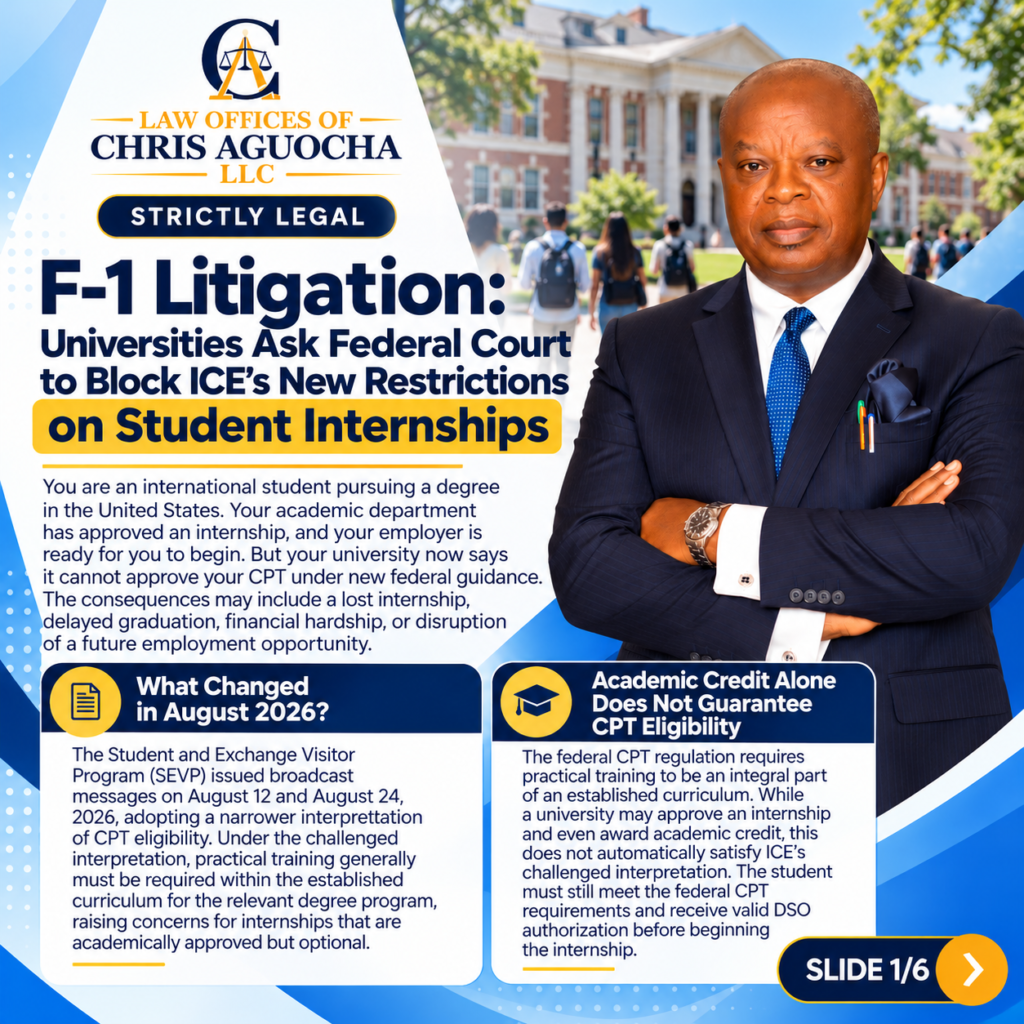
But your university’s international student office suddenly informs you that it cannot approve your Curricular Practical Training (CPT) request under new federal guidance.
The consequences may be immediate: a lost internship, delayed graduation, financial hardship, or disruption of a future employment opportunity.
On October 5, 2026, four major higher-education organizations filed a federal lawsuit challenging ICE’s new interpretation of CPT eligibility.
The litigation could affect how universities administer CPT. But students must continue complying with applicable employment authorization requirements while the case proceeds.
What Changed in August 2026?
The Student and Exchange Visitor Program (SEVP), administered by ICE, issued broadcast messages on August 12 and August 24, 2026, addressing CPT eligibility.
The messages adopted a narrower interpretation of the federal CPT regulation.
Under the challenged interpretation, practical training generally must be required within the established curriculum for students in the relevant degree program.
This approach raises particular concerns for internships that are academically approved but optional.
For example, a university may offer an internship course that awards academic credit but is not mandatory for every student completing the degree.
The fact that the university recognizes the internship academically may no longer satisfy ICE’s challenged interpretation.
The guidance also raises questions about the cooperative arrangements between educational institutions and training employers.
Academic Credit Alone Does Not Guarantee CPT Eligibility
The federal CPT regulation, 8 C.F.R. §214.2(f)(10)(i), addresses practical training that is an integral part of an established curriculum.
It identifies qualifying arrangements such as alternate work/study, internships, cooperative education, and other required internships or practicums offered through cooperative agreements with schools.
Historically, universities have administered CPT under established interpretations of this regulatory language.
The August 2026 SEVP messages introduced a more restrictive approach, particularly concerning optional internships and curriculum requirements.
The critical distinction is between:
Academic approval: The university determines that an internship has educational value or qualifies for academic credit.
Immigration authorization: The student satisfies the federal CPT requirements and receives valid DSO authorization.
One does not automatically establish the other.
Four Higher-Education Organizations Filed a Federal Lawsuit
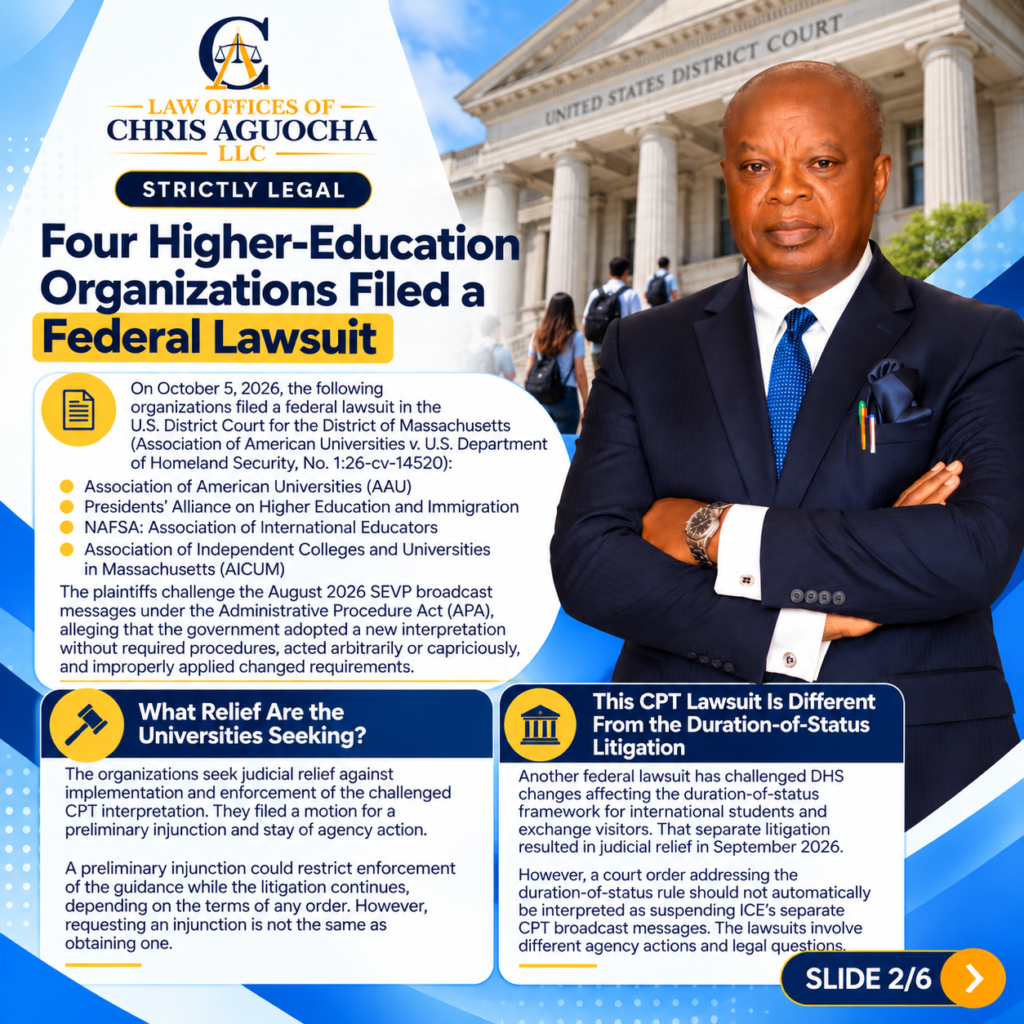
On October 5, 2026, the following organizations filed suit in the U.S. District Court for the District of Massachusetts:
- Association of American Universities (AAU);
- Presidents’ Alliance on Higher Education and Immigration;
- NAFSA: Association of International Educators; and
- Association of Independent Colleges and Universities in Massachusetts (AICUM).
The case is Association of American Universities v. U.S. Department of Homeland Security, No. 1:26-cv-14520.
The plaintiffs challenge the August SEVP broadcast messages under the Administrative Procedure Act (APA).
Their allegations include that the government adopted a new interpretation without legally required procedures, acted arbitrarily or capriciously, and improperly applied changed requirements to existing educational arrangements.
These are the plaintiffs’ legal allegations, not final judicial findings.
What Relief Are the Universities Seeking?
The organizations seek judicial relief against implementation and enforcement of the challenged CPT interpretation.
They filed a motion for a preliminary injunction and stay of agency action.
A preliminary injunction could restrict enforcement of the challenged guidance while the litigation continues, depending on the terms of any order.
But requesting an injunction is not the same as obtaining one.
As of October 16, 2026, I have not verified an order granting preliminary relief in this particular CPT case.
Students and universities should therefore verify the current docket and any operative court order before assuming that the August guidance has been suspended.
This CPT Lawsuit Is Different From the Duration-of-Status Litigation
Another federal lawsuit has challenged DHS changes affecting the duration-of-status framework for international students and exchange visitors.
That separate litigation resulted in judicial relief in September 2026.
However, a court order addressing the duration-of-status rule should not automatically be interpreted as suspending ICE’s separate CPT broadcast messages.
The lawsuits involve different agency actions and legal questions.
The actual scope of each court order controls.
What Is Curricular Practical Training?
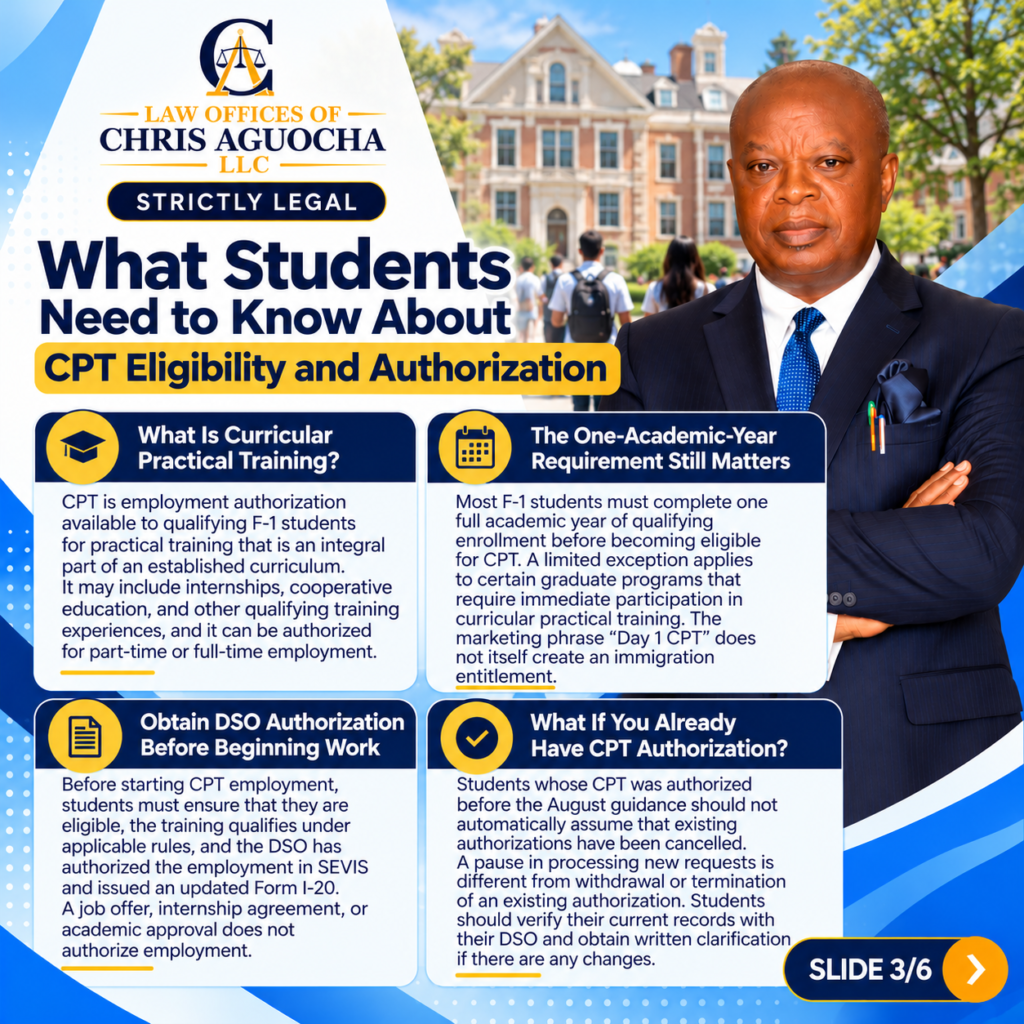
CPT is employment authorization available to qualifying F-1 students for practical training that is an integral part of an established curriculum.
Depending on the program and authorization, CPT may include internships, cooperative education, and other qualifying training experiences.
CPT may be authorized for part-time or full-time employment.
Unlike OPT, CPT generally does not require a separate employment authorization document issued by USCIS.
Instead, the student’s DSO must authorize the qualifying training in SEVIS and issue an updated Form I-20 reflecting the authorization.
A job offer, internship agreement, academic approval, or pending CPT request does not independently authorize employment.
The One-Academic-Year Requirement Still Matters
F-1 students generally must complete one full academic year of qualifying enrollment before becoming eligible for practical training.
A limited regulatory exception applies to certain graduate programs requiring immediate participation in curricular practical training.
This exception must be established through the actual program requirements.
The marketing phrase “Day 1 CPT” does not itself create an immigration entitlement.
Students should be cautious about programs promising immediate work authorization without examining the curriculum, accreditation, training requirements, and immigration compliance.
Obtain DSO Authorization Before Beginning Work
Before starting CPT employment, students should verify that:
- They are eligible for CPT;
- The training qualifies under applicable rules;
- The DSO has authorized the employment in SEVIS;
- An updated Form I-20 has been issued;
- The authorized employer is correctly identified;
- The authorized employment dates are correct; and
- The employment complies with any applicable location, hours, and training restrictions.
Students should not begin work merely because their professor, department chair, or employer has approved the internship.
The required immigration authorization must exist before employment begins.
What If You Already Have CPT Authorization?
Students whose CPT was authorized before the August guidance should not automatically assume that every existing authorization has been cancelled.
A pause in processing new requests is different from withdrawal or termination of an existing authorization.
However, students should verify their current records with their DSO.
If the school has shortened, withdrawn, or otherwise changed an authorization, the student should obtain written clarification before relying on an earlier Form I-20.
The relevant questions include whether the authorization remains active and whether the proposed work falls within its approved terms.
What If Your CPT Request Is Pending?
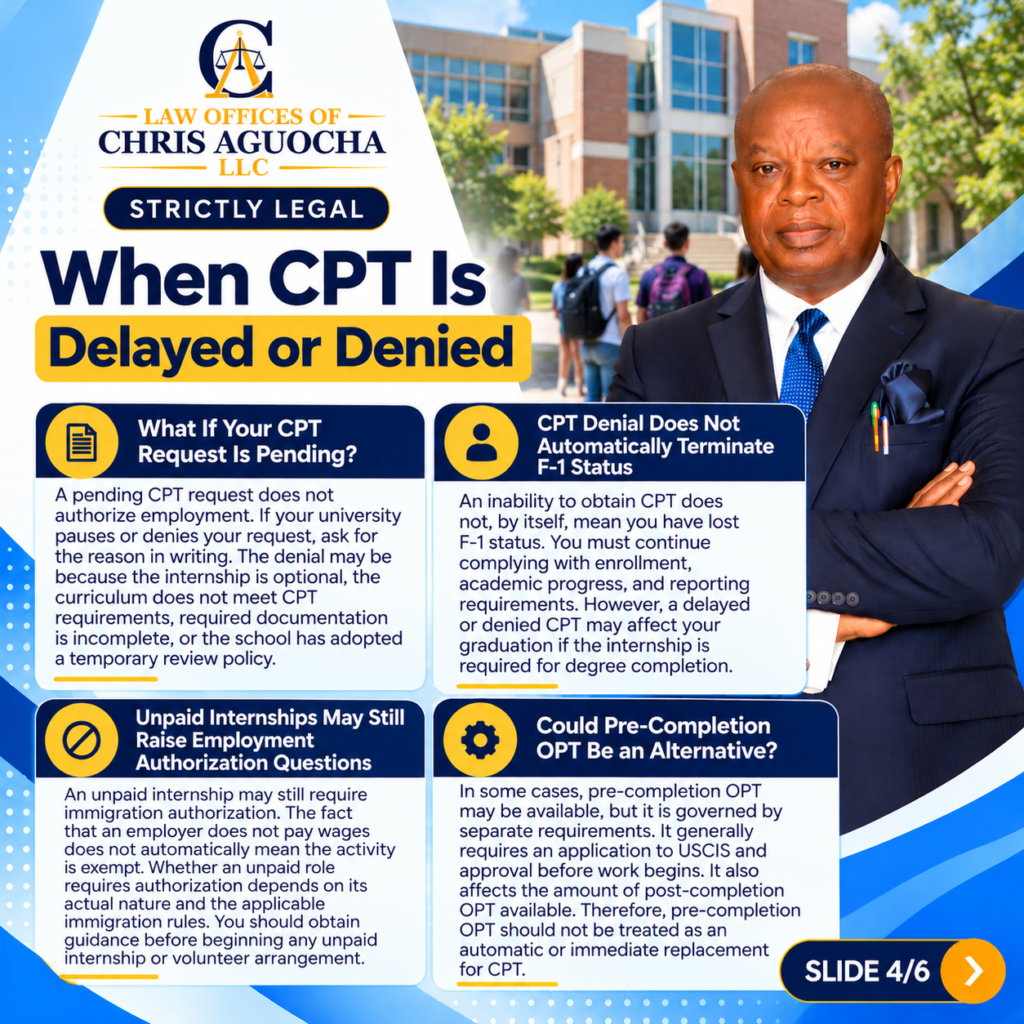
A pending CPT request does not authorize employment.
If the university pauses or denies a request, the student should ask for the reason in writing.
Possible explanations include:
- The internship is optional rather than required;
- The curriculum does not meet the school’s current interpretation of CPT requirements;
- A qualifying cooperative agreement is missing;
- The student has not met enrollment requirements;
- Required documentation is incomplete; or
- The institution has adopted a temporary review policy.
The student should ask whether an internal reconsideration process is available and whether the academic department can provide documentation supporting eligibility.
But neither the university nor an attorney can guarantee that a DSO will issue authorization.
CPT Denial Does Not Automatically Terminate F-1 Status
An inability to obtain CPT does not, by itself, mean the student has lost F-1 status.
The student must continue complying with applicable enrollment, academic progress, reporting, and other status requirements.
The problem may nevertheless affect graduation.
For example, if a particular internship is required for degree completion, a delayed CPT decision may prevent the student from completing an academic requirement on schedule.
That issue should be addressed promptly with the DSO and academic department.
CPT does not independently extend a student’s academic program or authorize remaining in the United States beyond the period otherwise permitted by law.
Unpaid Internships May Still Raise Employment Authorization Questions
Some students assume that an internship does not require immigration authorization if the employer does not pay wages.
That assumption can be dangerous.
Whether an unpaid activity constitutes employment or otherwise requires authorization depends on its actual nature and the applicable immigration rules.
The absence of a paycheck is not necessarily dispositive.
Students should obtain appropriate guidance before beginning unpaid internships, volunteer arrangements, or other practical training activities.
Could Pre-Completion OPT Be an Alternative?
In some cases, pre-completion Optional Practical Training may be available.
But pre-completion OPT is governed by separate requirements.
Unlike CPT, it generally requires an application to USCIS and approval of employment authorization before work begins.
Pre-completion OPT also affects the amount of post-completion OPT available at the same educational level.
Full-time pre-completion OPT is generally deducted from later post-completion OPT on a corresponding basis, while part-time pre-completion OPT is deducted at a reduced rate.
During periods when school is in session, pre-completion OPT employment is generally limited to 20 hours per week.
Therefore, pre-completion OPT should not be treated as an automatic or immediate replacement for CPT.
Full-Time CPT Can Affect Future OPT Eligibility
Another important rule concerns the relationship between CPT and OPT.
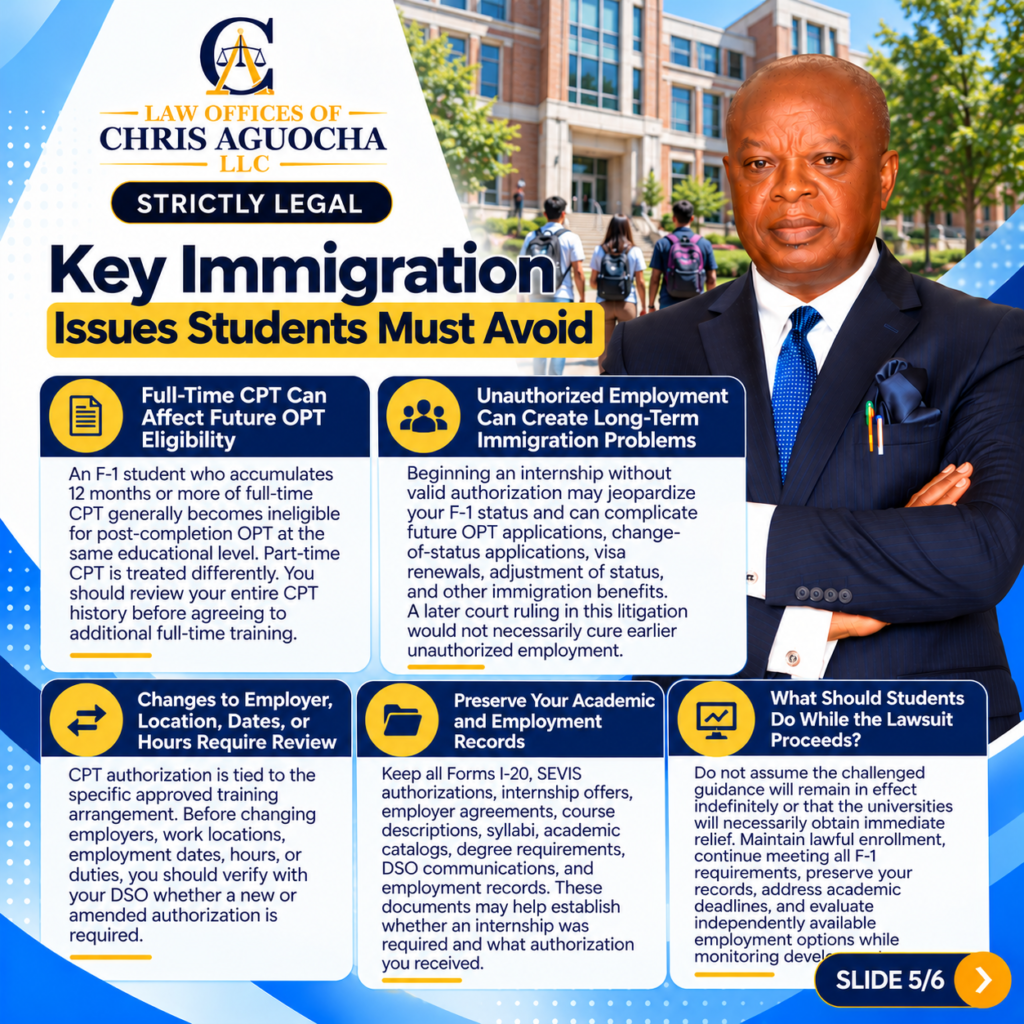
An F-1 student who accumulates 12 months or more of full-time CPT generally becomes ineligible for post-completion OPT at the same educational level.
Part-time CPT is treated differently for this purpose.
Students should review their entire CPT history before agreeing to additional full-time training.
The number of months, authorization dates, and whether the CPT was full-time or part-time can materially affect future eligibility.
Unauthorized Employment Can Create Long-Term Immigration Problems
Beginning an internship without valid authorization can have consequences beyond the immediate position.
Unauthorized employment may jeopardize F-1 status.
It may also complicate:
- Reinstatement;
- Future OPT applications;
- Change-of-status applications;
- Visa renewals;
- Adjustment of status; and
- Future immigration benefits.
A later favorable court ruling in the university litigation would not necessarily cure an individual’s earlier unauthorized employment.
Students who have already performed work without authorization should obtain individualized legal advice before making statements or filing new applications.
Changes to Employer, Location, Dates, or Hours Require Review
CPT authorization is tied to the specific approved training arrangement.
Before changing placements, students should verify whether the change requires a new or amended DSO authorization.
Potential changes include:
- A different employer;
- A different worksite;
- An extension of employment dates;
- A change from part-time to full-time work;
- Additional duties; or
- A different training arrangement.
Students should not assume that an earlier authorization automatically covers a materially different position.
Preserve Your Academic and Employment Records
Students affected by the guidance should maintain a complete record of their CPT eligibility and authorization history.
Relevant documents include:
- All Forms I-20;
- SEVIS authorization records;
- Internship offers;
- Employer agreements;
- Cooperative agreements;
- Course descriptions;
- Academic catalogs;
- Syllabi;
- Degree requirements;
- Proof of academic credit;
- DSO communications;
- University policy notices;
- Prior CPT approvals;
- Employment dates; and
- Relevant payroll or training records.
These documents may help establish whether an internship was required, how it fit within the curriculum, and what authorization the student actually received.
What Should Students Do While the Lawsuit Proceeds?
Students should avoid assuming either that the challenged guidance will remain in effect indefinitely or that the universities will necessarily obtain immediate relief.
The litigation outcome remains uncertain.
The appropriate response is to protect the student’s present immigration position while monitoring developments.
That includes maintaining lawful enrollment, preserving records, checking authorization dates, addressing academic deadlines, and evaluating independently available employment options.
Any later court order should be examined for its effective date, scope, and effect on previously issued or pending CPT decisions.
Key Takeaways
- Four higher-education organizations filed a federal lawsuit on October 5, 2026, challenging ICE’s August CPT guidance.
- The lawsuit alleges Administrative Procedure Act violations; those allegations have not been established by a final judgment.
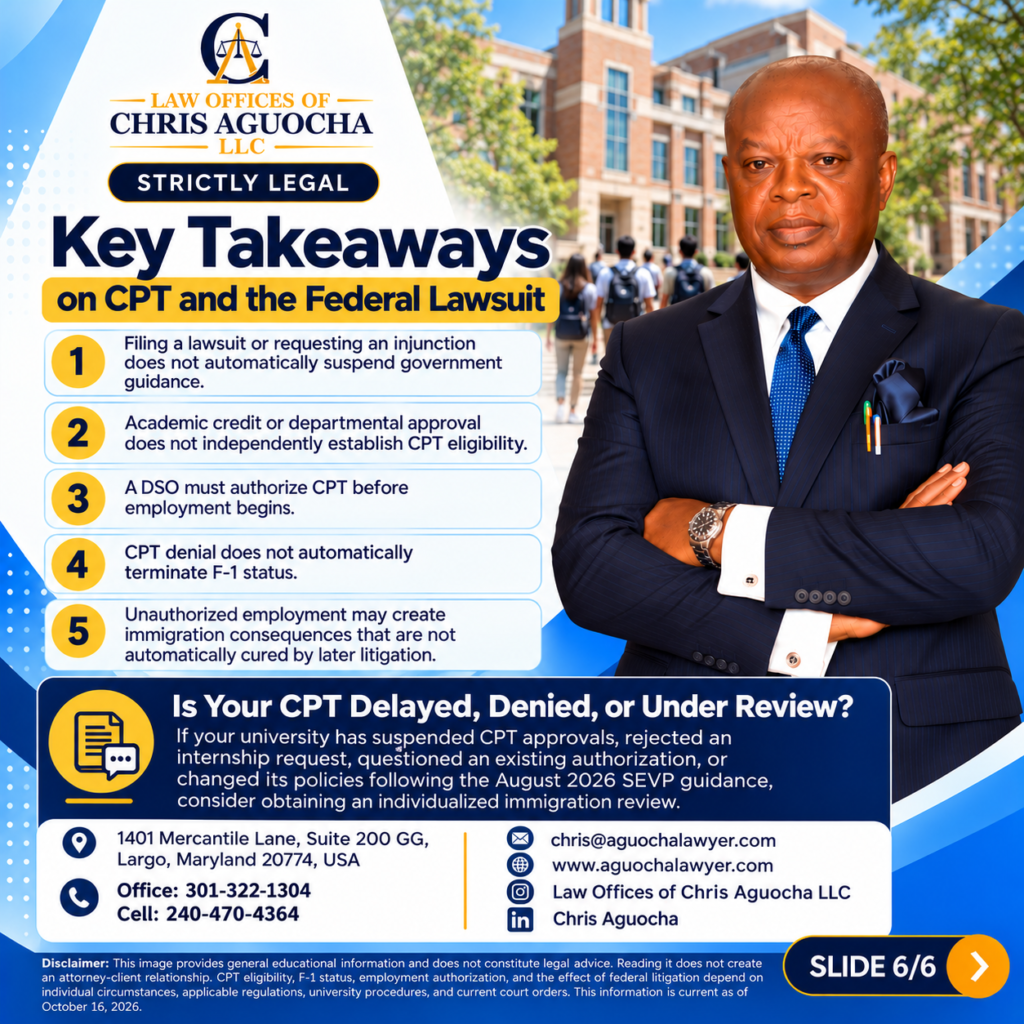
- Filing a lawsuit or requesting an injunction does not automatically suspend government guidance.
- The CPT litigation is separate from the duration-of-status litigation.
- Academic credit or departmental approval does not independently establish CPT eligibility.
- Most students must satisfy the one-academic-year requirement unless a qualifying exception applies.
- A DSO must authorize CPT before employment begins.
- Existing CPT approvals and pending requests require different legal analysis.
- CPT denial does not automatically terminate F-1 status.
- CPT does not independently extend an academic program.
- Unpaid internships may still require employment authorization.
- Pre-completion OPT requires separate approval and can reduce later OPT eligibility.
- Twelve months or more of full-time CPT generally eliminates OPT eligibility at the same educational level.
- Unauthorized employment may create immigration consequences that are not automatically cured by later litigation.
- Students should preserve their I-20s, training agreements, curriculum records, and school communications.
Is Your CPT Delayed, Denied, or Under Review?
If your university has suspended CPT approvals, rejected an internship request, questioned an existing authorization, or changed its policies following the August 2026 SEVP guidance, consider obtaining an individualized immigration review.
Our office can examine your F-1 status, CPT history, academic requirements, employer arrangements, authorization records, graduation timeline, and possible alternatives to help you make informed decisions while the litigation proceeds.
Law Offices of Chris Aguocha LLC
Office: 301-322-1304
Cell: 240-470-4364
Email: chris@aguochalawyer.com
Disclaimer: This article provides general educational information and does not constitute legal advice.
