





You entered the United States legally with a visitor visa.
You applied for asylum, attended immigration appointments, updated your address, and spent years living openly in the community while your case remained pending.
Then, during a scheduled immigration interview, ICE arrested you.
Your visitor admission may have expired years earlier. But does that automatically mean ICE can detain you without meaningful procedural protections?
No. The legality of your continued stay and the constitutionality of the procedures used to detain you are separate legal questions.
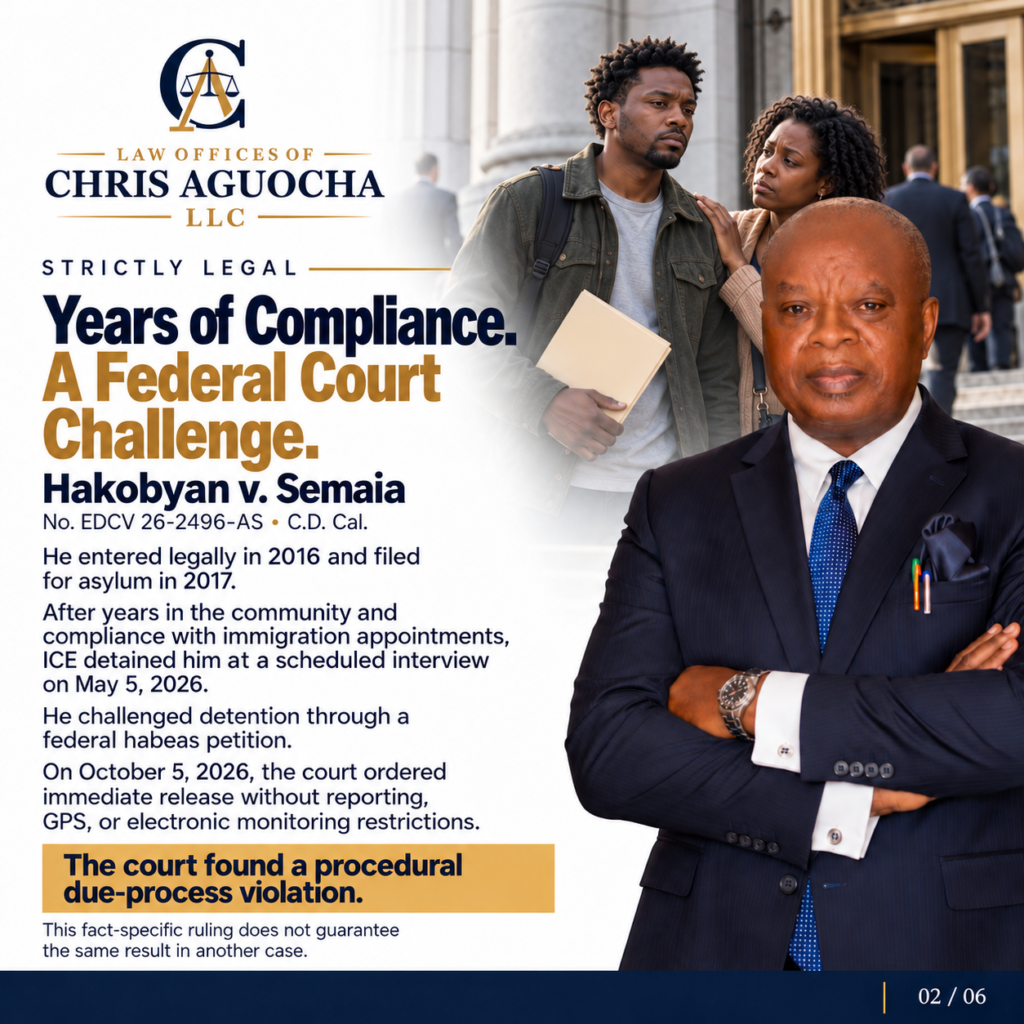
A significant federal court decision issued on October 5, 2026, illustrates how years of compliance and community residence may support a due-process challenge to immigration detention.
The case is Hakobyan v. Semaia, No. EDCV 26-2496-AS, decided by the U.S. District Court for the Central District of California.
An Expired Visitor Admission Does Not Eliminate Due Process
A visa and an authorized period of stay are not the same thing.
A visa generally permits a foreign national to seek admission to the United States. For a B-2 visitor, the Form I-94 ordinarily identifies the period of authorized stay.
Filing an asylum application does not automatically extend B-2 nonimmigrant status.
Likewise, obtaining an asylum-related employment authorization document does not independently restore visitor status.
An individual who remains beyond the authorized period may be subject to removal proceedings under INA §237(a)(1)(B).
But that does not resolve every question concerning detention.
The Fifth Amendment’s Due Process Clause protects persons within the United States, including noncitizens who lack lawful immigration status.
The scope of the required procedures depends on the applicable detention authority, governing precedent, and individual circumstances.
What Happened in Hakobyan v. Semaia?
Gevorg Hakobyan, a citizen of Armenia, lawfully entered the United States on November 23, 2016, using a B-2 visitor visa.
He filed an asylum application on March 13, 2017.
For nearly nine and a half years after entering the country, he remained outside immigration detention while pursuing his immigration case.
According to the court’s findings, Hakobyan complied with his immigration obligations and attended required appointments.
On May 5, 2026, he appeared for a scheduled immigration interview.
ICE detained him at that appointment.
DHS also served him with a Notice to Appear alleging that he had remained in the United States longer than permitted.
Hakobyan challenged his detention by filing a federal habeas corpus petition under 28 U.S.C. §2241.
The Federal Court Granted Habeas Relief
On October 5, 2026, U.S. Magistrate Judge Alka Sagar granted Hakobyan’s petition.
The court concluded that the government had violated his procedural due-process rights by detaining him without advance notice and a meaningful pre-deprivation opportunity to be heard before a neutral decisionmaker.
The court ordered his immediate release from immigration custody.
Importantly, the order required release without additional restrictions on his liberty, including reporting requirements, GPS monitoring, or electronic monitoring.
The court also prohibited the government from re-detaining him without strict compliance with applicable due-process requirements, statutes, and regulations.
This was a substantial remedy, but it arose from the facts and legal analysis of his individual case.
Why Did His Years of Freedom Matter?
The court emphasized that the government had known about Hakobyan’s presence and immigration proceedings for years.
He had filed for asylum in 2017.
He had remained available to immigration authorities.
He had attended required appointments.
Despite that knowledge, the government had allowed him to remain in the community for nearly nine years before arresting him.
The court treated that history as important to his protected liberty interest.
The reasoning reflects a fundamental constitutional concern: when the government has permitted an individual to live freely for an extended period, a sudden deprivation of physical liberty may require meaningful procedural safeguards.
However, years of community residence do not automatically establish a nationwide right to advance notice or a hearing before every immigration arrest.
The legal result depends on the applicable statute, judicial precedent, and particular circumstances.
Government Knowledge Does Not Create Lawful Immigration Status
A person may reasonably ask:
“If ICE knew where I lived and knew that my asylum application was pending, how can it suddenly arrest me?”
Government knowledge and immigration status are different legal matters.
The fact that USCIS or ICE knows an individual’s address does not automatically grant lawful status.
Attending appointments does not independently eliminate removability.
And a pending asylum application does not automatically prevent ICE detention.
Nevertheless, government knowledge and a consistent record of compliance may be relevant to a procedural due-process challenge.
The question is not simply whether ICE had authority to initiate removal proceedings.
It is also whether the government complied with the constitutional and statutory requirements governing the particular detention.
Initial Detention and Re-Detention Require Different Analysis
Not every immigration custody case involves the same factual situation.
Consider two examples.
Example One: Initial detention after years in the community
A person has never been held in immigration custody, has lived openly for many years, and is arrested at a scheduled immigration appointment.
Example Two: Re-detention after formal release
A person was previously detained, released on bond or supervision, complied with conditions, and was later taken back into custody.
Both circumstances may raise due-process concerns.
But they are not legally identical.
Prior custody decisions, formal release conditions, compliance history, the asserted detention statute, and materially changed circumstances may affect the required procedures.
Counsel should identify the actual custody history before selecting the legal theory.
What About a Prior Arrest That Was Dismissed?
The government relied in part on Hakobyan’s prior battery arrest, although the charge had been dismissed in 2024.
This raises another important distinction.
An arrest is not a criminal conviction.
A dismissed charge does not automatically establish that the person committed the alleged conduct.
At the same time, immigration custody determinations may permit consideration of reliable evidence concerning underlying conduct in circumstances where a conviction is not required.
Accordingly, counsel should examine:
- The original charge;
- The final disposition;
- Whether the case was dismissed;
- The underlying evidence;
- Whether the government knew about the incident before detention;
- Whether the person had an opportunity to respond; and
- Whether the asserted evidence actually supports the custody determination.
A dismissal should not be misrepresented as a conviction, but neither should counsel assume that the dismissal makes all underlying evidence legally irrelevant.
Can a Person Seek Bond?
Depending on the applicable immigration detention statute, an individual may be eligible for a bond hearing before an Immigration Judge.
The analysis may involve INA §236, 8 U.S.C. §1226, or another detention provision.
Some individuals are subject to mandatory detention or restrictions on ordinary Immigration Judge bond jurisdiction.
Others may seek custody redetermination.
A bond proceeding may address issues such as danger, flight risk, and eligibility for release.
However, a bond proceeding does not necessarily resolve an independent constitutional challenge to the procedures used before detention.
The two avenues should not automatically be treated as interchangeable.
Can Federal Habeas Corpus Help?
Federal habeas corpus under 28 U.S.C. §2241 may provide a means to challenge the legality of immigration custody.
Depending on the case, the requested relief may include:
- Immediate release;
- A constitutionally adequate custody hearing;
- Reconsideration of detention under the proper legal standard;
- Relief from unlawful custody conditions; or
- Protection against re-detention without legally required procedures.
But federal habeas relief is not automatic.
Jurisdictional restrictions, exhaustion questions, the applicable detention statute, the location of custody, and controlling circuit law may affect the available claims and remedies.
The fact that Hakobyan obtained unrestricted release does not mean every similarly situated asylum applicant will receive the same remedy.
What Makes a Compliance History Important?
An individual who has attended appointments and remained available to immigration authorities may possess evidence relevant to a custody challenge.
Useful documents include:
- Asylum filing receipts;
- Copies of Form I-589;
- USCIS interview notices;
- Immigration Court hearing notices;
- Proof of attendance;
- Address-change confirmations;
- ICE reporting records;
- Orders of supervision;
- Employment authorization documents;
- Tax records;
- Evidence of stable residence;
- Family responsibilities;
- Community ties; and
- Communications with immigration authorities.
These records can help reconstruct what the government knew, when it knew it, and how the individual responded to immigration obligations.
The Location of Detention Can Affect the Legal Strategy
ICE may transfer a detainee from one state to another.
Such transfers can complicate the legal response.
Counsel should promptly determine the detainee’s physical location, the proper habeas respondent, the appropriate federal district, and the controlling circuit precedent.
A decision from the Central District of California is not automatically binding on federal district courts in Maryland, Virginia, New York, or other jurisdictions.
The Ninth Circuit’s governing law may differ from the law applicable elsewhere.
Therefore, a habeas strategy must be adapted to the detainee’s actual location and procedural circumstances.
What Should Families Do Immediately After an Appointment Arrest?
The first priority is to locate the detainee and obtain reliable information.
Family members should preserve the appointment notice and document exactly what occurred.
Important information includes:
- The detainee’s full name;
- A-number;
- Date and location of arrest;
- Current detention facility;
- Identity of the arresting agency;
- Any Notice to Appear;
- Custody paperwork;
- Immigration filing history;
- Prior removal orders, if any;
- Existing court dates;
- Prior supervision requirements; and
- Any transfer information.
Family members should also identify witnesses and preserve relevant communications.
An attorney can then evaluate the custody authority, available release procedures, and whether emergency federal-court intervention is appropriate.
Continue Protecting the Underlying Asylum Case
A successful custody challenge does not automatically result in asylum approval.
It also does not restore expired B-2 status or dismiss removal charges.
The asylum application must continue to be handled according to its own legal requirements.
Counsel should determine whether the case is before USCIS, an Immigration Judge, or the Board of Immigration Appeals.
Deadlines, hearings, evidence submissions, and appeal rights must be protected.
Likewise, filing a habeas petition does not automatically stay removal.
Where there is a risk of removal, any necessary request for a stay requires separate and prompt legal evaluation.
The Legal Significance of Hakobyan
The October 5 ruling demonstrates that a federal court may examine more than the government’s allegation that a noncitizen overstayed an authorized period of admission.
The court may also consider the individual’s history of community residence, compliance with immigration obligations, the government’s knowledge, and the procedures used to deprive the person of liberty.
That is the central lesson of the decision.
Removability and detention are related, but they are not the same legal question.
A person may have a genuine removability issue and still possess a potentially meritorious constitutional challenge to detention.
Key Takeaways
- Pending asylum does not automatically prevent ICE detention.
- An expired B-2 admission may create a removability issue without eliminating constitutional due-process protections.
- In Hakobyan v. Semaia, the court granted habeas relief after examining nearly nine and a half years of community residence and compliance.
- The court ordered release without monitoring or reporting restrictions and prohibited unlawful re-detention.
- The decision is fact-specific and does not create a nationwide entitlement to advance notice or unrestricted release.
- Government knowledge of an asylum application does not automatically confer lawful status.
- Initial detention after years of freedom may raise different issues from re-detention following formal release.
- A dismissed criminal charge is not a conviction, although reliable underlying evidence may require separate analysis.
- Bond and federal habeas proceedings provide different potential remedies.
- Detention location and controlling circuit precedent can materially affect the legal strategy.
- Compliance records, appointment notices, and government communications should be preserved.
- A successful detention challenge does not automatically grant asylum, restore visitor status, or terminate removal proceedings.
Arrested by ICE at an Asylum Interview or Immigration Appointment?
If you or a family member was detained while attending a USCIS interview, ICE reporting appointment, or another immigration proceeding after years of compliance, immediate legal review may be important.
Our office can evaluate the statutory basis for detention, compliance history, custody procedures, bond eligibility, federal habeas options, transfer issues, and the underlying asylum or removal case.
Law Offices of Chris Aguocha LLC
Office: 301-322-1304
Cell: 240-470-4364
Email: chris@aguochalawyer.com
Disclaimer: This article provides general educational information and does not constitute legal advice.
