





For international students pursuing education in the United States, Optional Practical Training (OPT) can be an important bridge between academic study and professional experience.
But a new Department of Homeland Security proposal could substantially change the financial conditions under which schools recommend students for OPT.
On October 8, 2026, DHS published a proposed rule that would require Student and Exchange Visitor Program (SEVP)-certified institutions to pay $70,000 for an initial OPT recommendation and $30,000 for certain subsequent OPT recommendations.
These fees are proposed. They are not currently in effect.
Students should not abandon their academic programs, employment opportunities, or existing OPT plans based solely on a proposed rule.
They should, however, understand how the proposal could affect their school, future recommendations, and immigration timelines.
A Proposed Rule Is Not a Current Payment Requirement
DHS published the proposed rule in the Federal Register on October 8, 2026.
The notice establishes two different comment deadlines:
- November 9, 2026: Deadline for substantive public comments on the proposed rule.
- December 7, 2026: Deadline for comments concerning the information-collection provisions under the Paperwork Reduction Act.
Neither deadline makes the proposed fees effective.
DHS proposes that a final rule, if adopted, would take effect 60 days after publication in the Federal Register.
The final rule could differ from the proposal, including in its fee structure, transition provisions, and implementation requirements.
Until a legally effective change occurs, students should continue complying with the OPT requirements currently applicable to their cases.
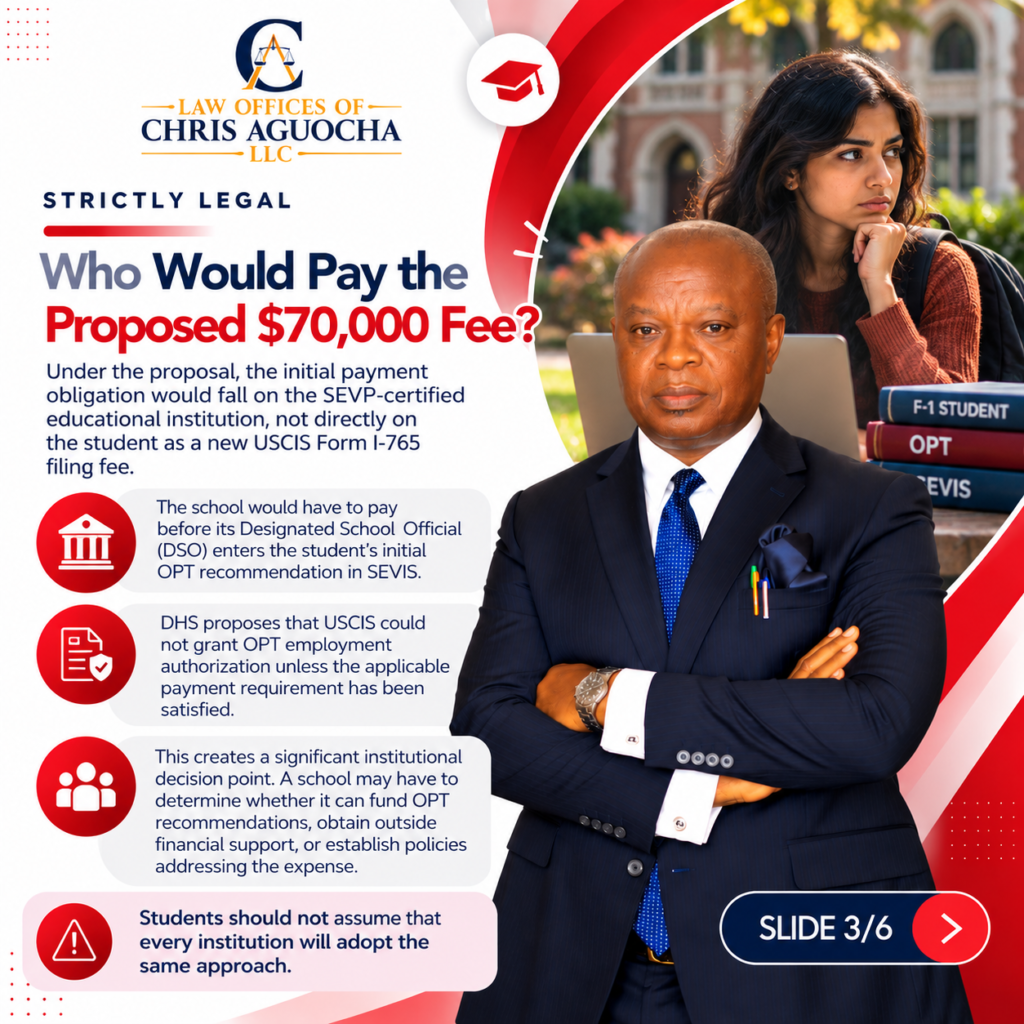
Who Would Pay the Proposed $70,000 Fee?
Under the proposal, the initial payment obligation would fall on the SEVP-certified educational institution, not directly on the student as a new USCIS Form I-765 filing fee.
The school would have to pay before its Designated School Official (DSO) enters the student’s initial OPT recommendation in SEVIS.
DHS also proposes that USCIS could not grant OPT employment authorization unless the applicable payment requirement had been satisfied.
This would create a significant institutional decision point.
A school might have to determine whether it can fund OPT recommendations, obtain outside financial support, or establish policies addressing the expense.
Students should not assume that every institution will adopt the same approach.
Could the School Pass the Cost to Students or Employers?
The proposal places the federal payment obligation on the institution.
However, the practical financial burden could become more complicated if a school seeks contributions or reimbursement from students, employers, or other sources.
Any proposed arrangement should be reviewed under applicable law and the institution’s policies.
Before signing a funding or reimbursement agreement, students should understand:
- Who is legally obligated to pay;
- Whether the payment is refundable;
- Whether the employer is contributing;
- What happens if USCIS denies the application;
- What happens if the student changes employers;
- Whether repayment is required after resignation or termination; and
- Whether the agreement creates additional financial or contractual obligations.
Payment would not guarantee an OPT recommendation, EAD approval, or continued employment.
The First OPT Recommendation Could Trigger $70,000
The proposal would apply the initial $70,000 payment to a student’s first qualifying OPT recommendation.
That first recommendation could involve:
- Pre-completion OPT;
- Post-completion OPT; or
- Another qualifying initial OPT period.
This distinction matters because students sometimes assume that OPT begins only after graduation.
Pre-completion OPT is also part of the OPT framework.
Under the proposed fee structure, using pre-completion OPT could therefore affect the financial requirements for a later post-completion recommendation.
Subsequent OPT Could Require Another $30,000
DHS proposes a $30,000 fee for subsequent OPT recommendations where the student has previously participated in OPT and the initial $70,000 fee has been paid.
That could include a later post-completion OPT period or a qualifying STEM OPT extension.
For example, under the proposal, a student whose institution pays $70,000 for initial post-completion OPT and later pays $30,000 for a STEM extension could generate a combined institutional payment of:
$100,000.
That is a conditional illustration of the proposed structure—not a current fee or an amount that every OPT student would necessarily incur.
Students Already on OPT Face an Important Transition Question
One of the most consequential features of the proposal concerns students who already have OPT authorization.
Under the proposed transition language, a DSO recommendation dated on or after the final rule’s effective date would trigger the $70,000 initial fee where the student had not previously paid that fee under the new framework.
The proposed $30,000 subsequent fee is expressly linked to prior payment of the $70,000 initial fee.
Therefore, a student who obtained post-completion OPT under existing rules should not assume that a later STEM OPT recommendation would automatically qualify for the lower $30,000 amount.
The transition provisions could make the recommendation date and prior payment history particularly important.
Students approaching a STEM extension should review their actual timelines rather than relying on general assumptions about grandfathering.
A School’s Refusal to Recommend OPT Can Create an Immediate Problem
OPT generally requires a qualifying DSO recommendation before the student submits the corresponding employment authorization application to USCIS.
If an institution declines to recommend OPT, the student should request a written explanation.
The reason may involve:
- Immigration eligibility;
- Missing documentation;
- Academic requirements;
- Funding;
- Institutional policy; or
- Another administrative issue.
Those circumstances require different responses.
Where time remains, the student may need to pursue an available institutional review process, correct missing documentation, or evaluate another lawful option.
But an immigration attorney cannot guarantee that a school will issue an OPT recommendation.
Existing OPT Filing Deadlines Still Matter
Students should not allow speculation about future fees to cause them to miss existing filing deadlines.
Under the current OPT framework, post-completion OPT applications generally must satisfy specific filing windows tied to program completion and the DSO recommendation.
STEM OPT extensions have separate timing requirements.
Submitting an application too early, too late, or with an outdated recommendation can create problems independent of any new fee proposal.
A proposed rule does not suspend current filing requirements.
Students approaching graduation should review their timelines with their DSO and, where appropriate, immigration counsel.
Protect Immigration Status Separately From Work Authorization
Another dangerous assumption is that the loss of an OPT opportunity automatically creates permission to remain in the United States until another employment option becomes available.
It does not.
Students should distinguish between:
F-1 status: The legal framework governing their presence and academic activities.
OPT employment authorization: Permission to engage in qualifying practical training under the applicable rules.
A grace period: A limited period that may permit certain immigration steps after qualifying completion or other events but does not itself authorize employment.
Another immigration classification: A separate status or benefit for which the student must independently qualify.
If OPT becomes unavailable, the student may need to evaluate further study, transfer, change of status, departure, or another lawful immigration strategy.
None should be assumed automatically available.
CPT Is Not an Automatic Replacement for OPT
Curricular Practical Training (CPT) has different eligibility requirements.
CPT generally must be an integral part of an established curriculum and must receive appropriate DSO authorization before the employment begins.
A student cannot simply relabel ordinary employment as CPT because OPT has become financially difficult.
Improper CPT arrangements can create status and future immigration problems.
Likewise, enrolling in another degree program does not automatically preserve employment authorization or guarantee another OPT opportunity.
What Happens When a STEM OPT Student Changes Employers?
The proposed fees are tied to qualifying OPT recommendations rather than automatically to every employer change.
That distinction matters.
A STEM OPT student who changes employers must still comply with the applicable STEM requirements, including the Form I-983 training-plan process and required reporting or DSO updates.
But an employer change should not automatically be described as triggering another $30,000 federal payment under the proposed text.
The final rule and any implementing guidance would need to be reviewed to determine how particular SEVIS actions are treated.
Refunds Would Be Limited and Discretionary
The proposal includes a refund mechanism, but it is not an unconditional guarantee.
Under the proposed framework, a school could request a refund before the relevant OPT EAD is issued, subject to specified conditions.
The DSO would have to remove the associated OPT recommendation from SEVIS before the refund request.
SEVP would then consider the request on a case-by-case basis.
The proposal also provides that the fee would not be refunded after the associated OPT EAD has been issued.
Students and employers should therefore avoid assuming that an unsuccessful employment arrangement, resignation, or changed plan would automatically produce reimbursement.
Private reimbursement agreements present separate contractual questions.
What If the Final Rule Is Challenged in Federal Court?
A final rule of this magnitude could become the subject of litigation.
But filing a lawsuit does not automatically suspend a federal regulation.
The relevant questions would include whether a court has issued a stay, preliminary injunction, or other enforceable order and whom that order covers.
Students should not rely on headlines announcing a lawsuit without verifying the actual legal effect of the court’s ruling.
DHS Is Also Considering an Alternative Fee Structure
DHS has invited comments on an alternative approach that could impose another initial $70,000 payment when a student progresses to a higher educational level.
For example, this could affect a student who completes a bachelor’s degree, participates in OPT, and later pursues a master’s degree.
That alternative has not been adopted.
Students should not enroll in unnecessary academic programs solely to avoid a proposed fee, nor should they assume that pursuing another degree guarantees future employment authorization.
Further study should reflect legitimate academic objectives and compliance with the immigration rules applicable at the time.
What F-1 Students Should Do Now
Students concerned about the proposal should begin with their own immigration records and deadlines.
A useful review should include:
- Current Form I-20 and SEVIS record;
- Program completion date;
- Prior pre-completion or post-completion OPT;
- Existing EAD and expiration date;
- Pending Form I-765 applications;
- DSO recommendation dates;
- STEM OPT eligibility and employer compliance;
- School funding policies;
- Employer reimbursement agreements;
- Possible status or employment alternatives; and
- Any future final rule and its transition provisions.
The objective is to make decisions based on the student’s actual eligibility and timeline—not assumptions about what the final regulation will say.
Bottom Lines
- The proposed $70,000 initial OPT fee and $30,000 subsequent OPT fee are not currently effective.
- The November 9 and December 7 comment deadlines do not activate the fees.
- The proposed federal payment obligation would fall on SEVP-certified institutions before qualifying DSO recommendations.
- Payment would not guarantee OPT eligibility, USCIS approval, or employment authorization.
- The proposed $30,000 subsequent fee depends on prior payment of the $70,000 initial fee.
- Students already on OPT should carefully examine the proposed transition provisions before assuming a future STEM extension would qualify for the lower fee.
- Employer changes do not automatically trigger another payment under the proposed fee structure.
- Refunds would be limited and discretionary.
- Students must continue complying with existing OPT filing deadlines, F-1 requirements, and STEM reporting obligations.
- Further study, CPT, and other visa categories are not automatic substitutes for OPT.
- A future lawsuit would not automatically suspend an effective rule without applicable judicial relief.
Concerned About the Proposed OPT Fees?
If you are an F-1 student approaching graduation, applying for post-completion OPT, planning a STEM extension, or facing uncertainty about your school’s future OPT recommendations, consider obtaining an individualized immigration review before changing your academic or employment plans.
Our office can examine your OPT history, SEVIS records, DSO recommendation dates, filing deadlines, employment arrangements, F-1 status, and potential immigration alternatives to develop a strategy based on the rules actually applicable to your circumstances.
Law Offices of Chris Aguocha LLC
Office: 301-322-1304
Cell: 240-470-4364
Email: chris@aguochalawyer.com
Disclaimer: This article is provided for general educational purposes only and does not constitute legal advice.
