
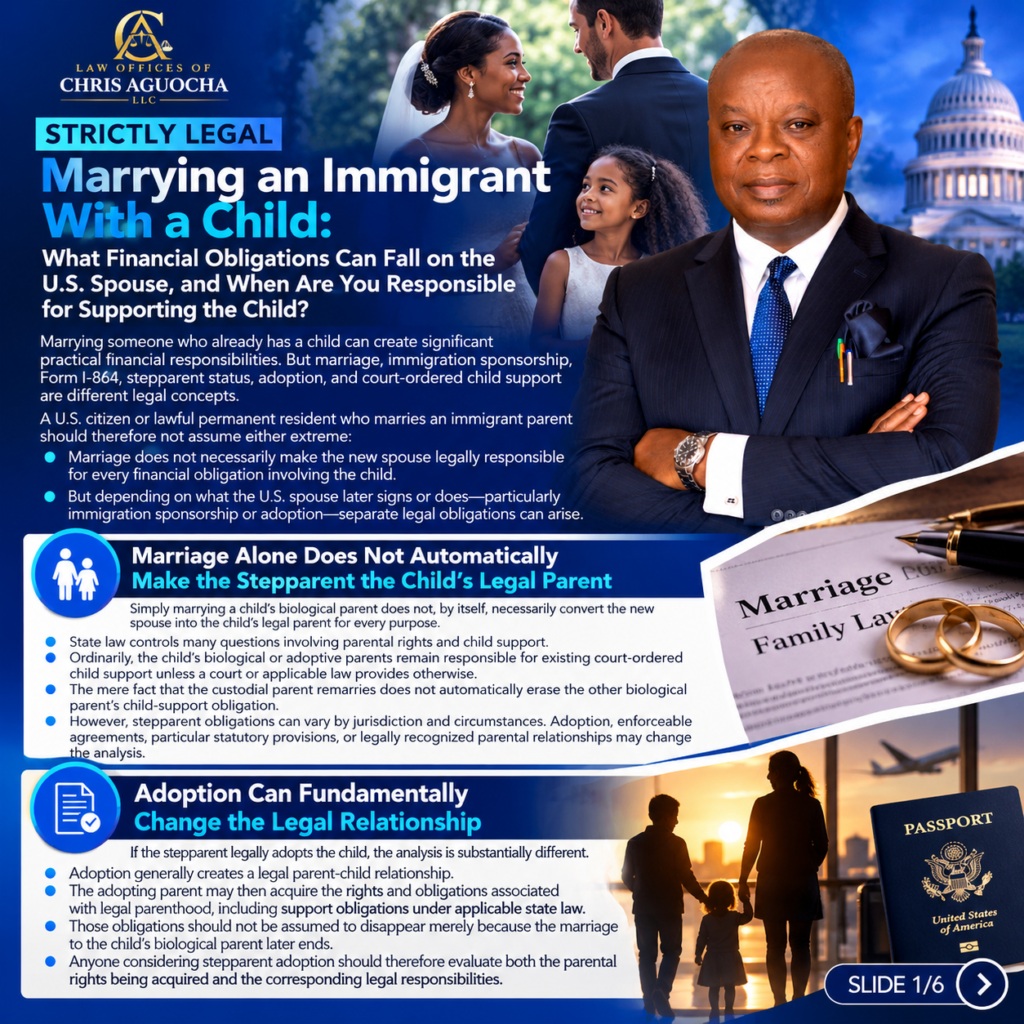
Marrying someone who already has a child can create significant practical financial responsibilities. But marriage, immigration sponsorship, Form I-864, stepparent status, adoption, and court-ordered child support are different legal concepts.
A U.S. citizen or lawful permanent resident who marries an immigrant parent should therefore not assume either extreme:
Marriage does not necessarily make the new spouse legally responsible for every financial obligation involving the child.
But depending on what the U.S. spouse later signs or does—particularly immigration sponsorship or adoption—separate legal obligations can arise.
Marriage Alone Does Not Automatically Make the Stepparent the Child’s Legal Parent
Simply marrying a child’s biological parent does not, by itself, necessarily convert the new spouse into the child’s legal parent for every purpose.
State law controls many questions involving parental rights and child support.
Ordinarily, the child’s biological or adoptive parents remain responsible for existing court-ordered child support unless a court or applicable law provides otherwise.
The mere fact that the custodial parent remarries does not automatically erase the other biological parent’s child-support obligation.
However, stepparent obligations can vary by jurisdiction and circumstances. Adoption, enforceable agreements, particular statutory provisions, or legally recognized parental relationships may change the analysis.
Adoption Can Fundamentally Change the Legal Relationship
If the stepparent legally adopts the child, the analysis is substantially different.
Adoption generally creates a legal parent-child relationship.
The adopting parent may then acquire the rights and obligations associated with legal parenthood, including support obligations under applicable state law.
Those obligations should not be assumed to disappear merely because the marriage to the child’s biological parent later ends.
Anyone considering stepparent adoption should therefore evaluate both the parental rights being acquired and the corresponding legal responsibilities.
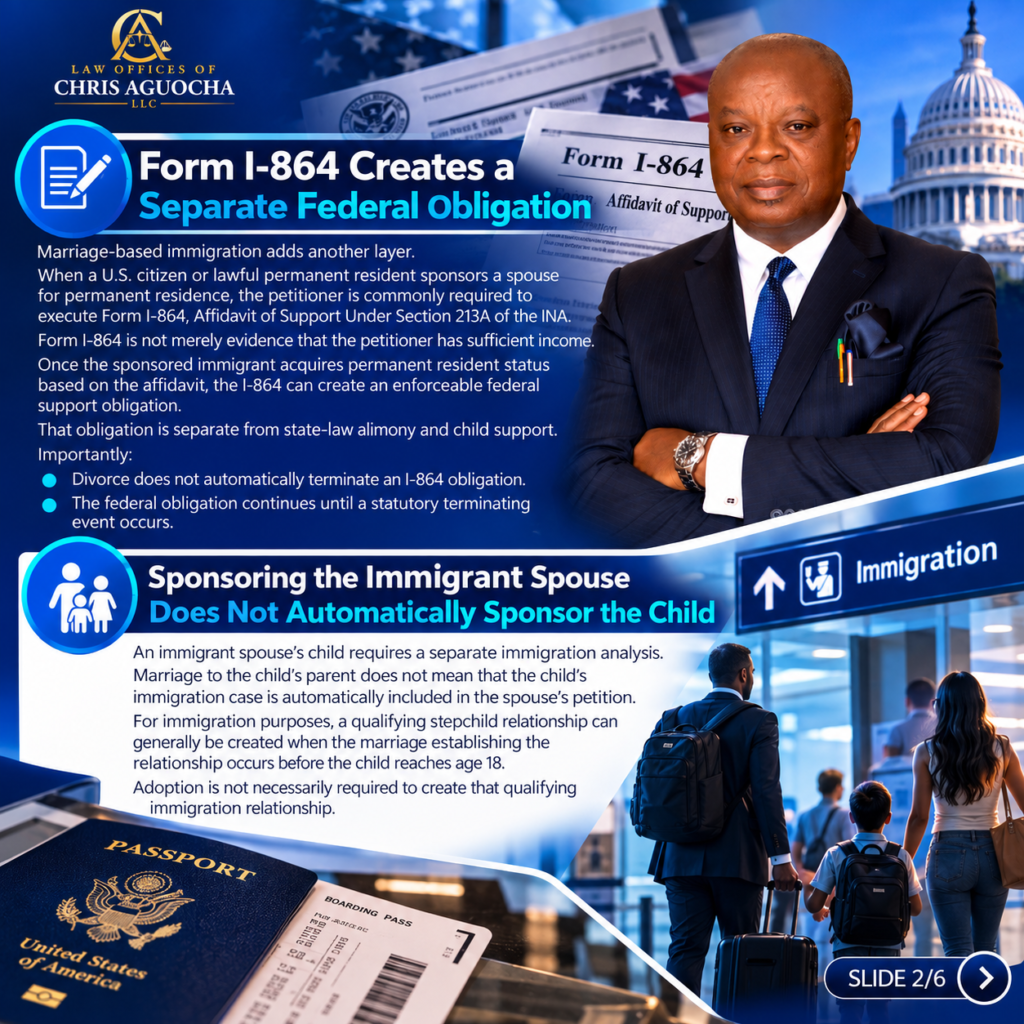
Form I-864 Creates a Separate Federal Obligation
Marriage-based immigration adds another layer.
When a U.S. citizen or lawful permanent resident sponsors a spouse for permanent residence, the petitioner is commonly required to execute Form I-864, Affidavit of Support Under Section 213A of the INA.
Form I-864 is not merely evidence that the petitioner has sufficient income.
Once the sponsored immigrant acquires permanent resident status based on the affidavit, the I-864 can create an enforceable federal support obligation.
That obligation is separate from state-law alimony and child support.
Importantly:
Divorce does not automatically terminate an I-864 obligation.
The federal obligation continues until a statutory terminating event occurs.
Sponsoring the Immigrant Spouse Does Not Automatically Sponsor the Child
An immigrant spouse’s child requires a separate immigration analysis.
Marriage to the child’s parent does not mean that the child’s immigration case is automatically included in the spouse’s petition.
For immigration purposes, a qualifying stepchild relationship can generally be created when the marriage establishing the relationship occurs before the child reaches age 18.
Adoption is not necessarily required to create that qualifying immigration relationship.
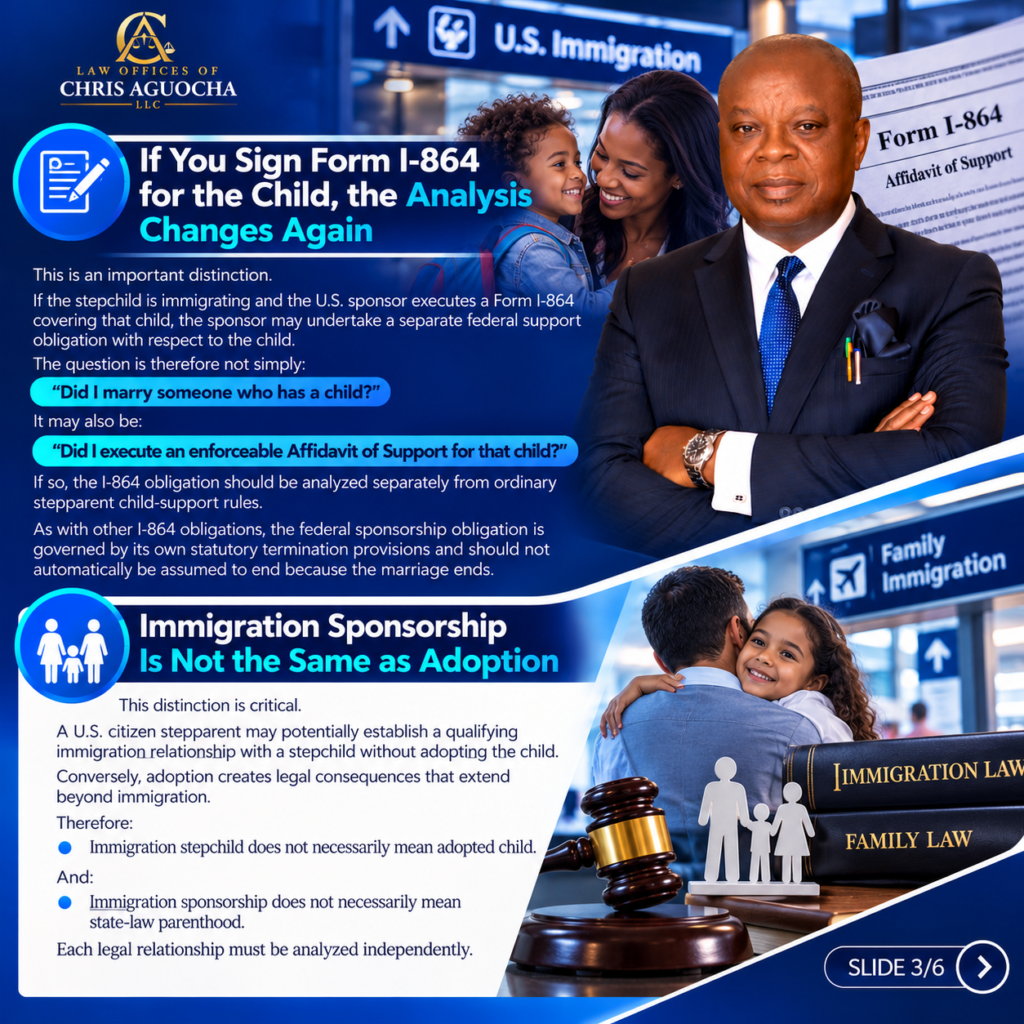
If You Sign Form I-864 for the Child, the Analysis Changes Again
This is an important distinction.
If the stepchild is immigrating and the U.S. sponsor executes a Form I-864 covering that child, the sponsor may undertake a separate federal support obligation with respect to the child.
The question is therefore not simply:
“Did I marry someone who has a child?”
It may also be:
“Did I execute an enforceable Affidavit of Support for that child?”
If so, the I-864 obligation should be analyzed separately from ordinary stepparent child-support rules.
As with other I-864 obligations, the federal sponsorship obligation is governed by its own statutory termination provisions and should not automatically be assumed to end because the marriage ends.
Immigration Sponsorship Is Not the Same as Adoption
This distinction is critical.
A U.S. citizen stepparent may potentially establish a qualifying immigration relationship with a stepchild without adopting the child.
Conversely, adoption creates legal consequences that extend beyond immigration.
Therefore:
Immigration stepchild does not necessarily mean adopted child.
And:
Immigration sponsorship does not necessarily mean state-law parenthood.
Each legal relationship must be analyzed independently.
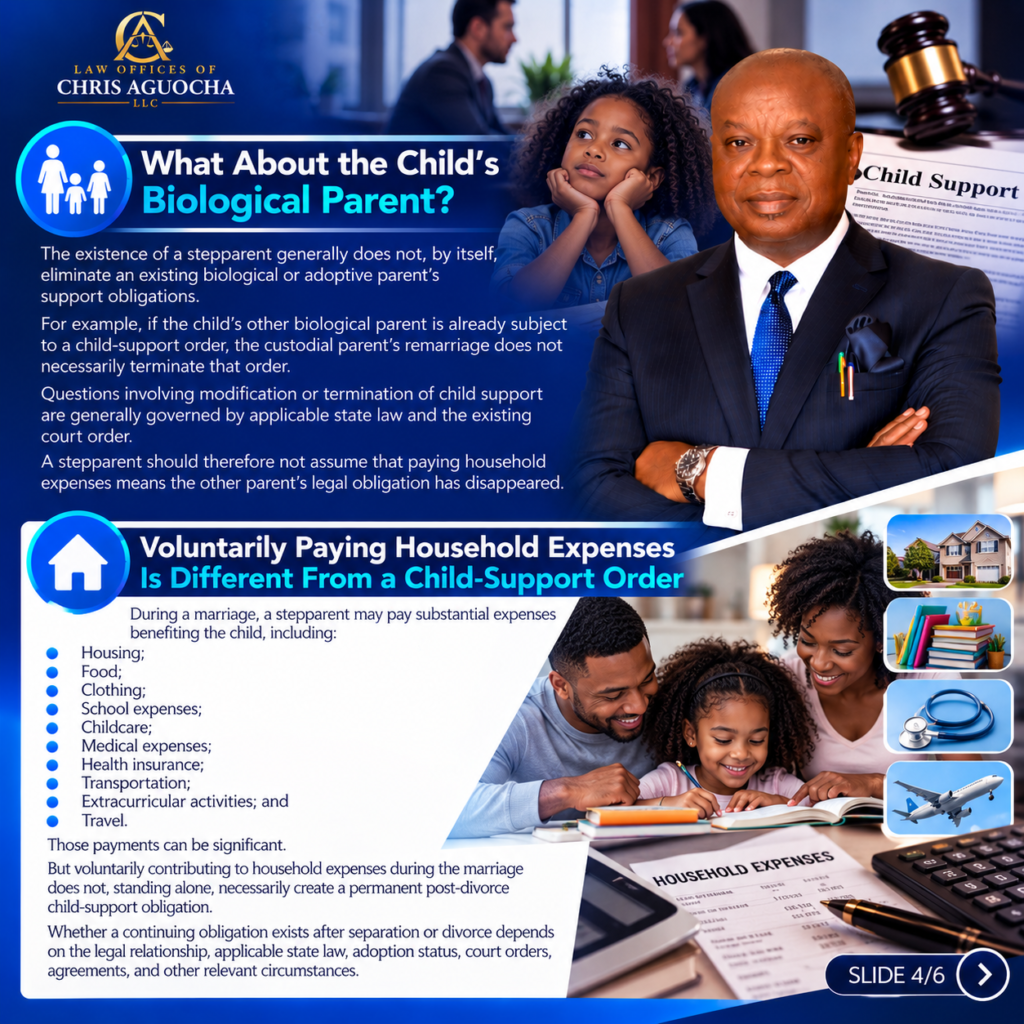
What About the Child’s Biological Parent?
The existence of a stepparent generally does not, by itself, eliminate an existing biological or adoptive parent’s support obligations.
For example, if the child’s other biological parent is already subject to a child-support order, the custodial parent’s remarriage does not necessarily terminate that order.
Questions involving modification or termination of child support are generally governed by applicable state law and the existing court order.
A stepparent should therefore not assume that paying household expenses means the other parent’s legal obligation has disappeared.
Voluntarily Paying Household Expenses Is Different From a Child-Support Order
During a marriage, a stepparent may pay substantial expenses benefiting the child, including:
• Housing;
• Food;
• Clothing;
• School expenses;
• Childcare;
• Medical expenses;
• Health insurance;
• Transportation;
• Extracurricular activities; and
• Travel.
Those payments can be significant.
But voluntarily contributing to household expenses during the marriage does not, standing alone, necessarily create a permanent post-divorce child-support obligation.
Whether a continuing obligation exists after separation or divorce depends on the legal relationship, applicable state law, adoption status, court orders, agreements, and other relevant circumstances.
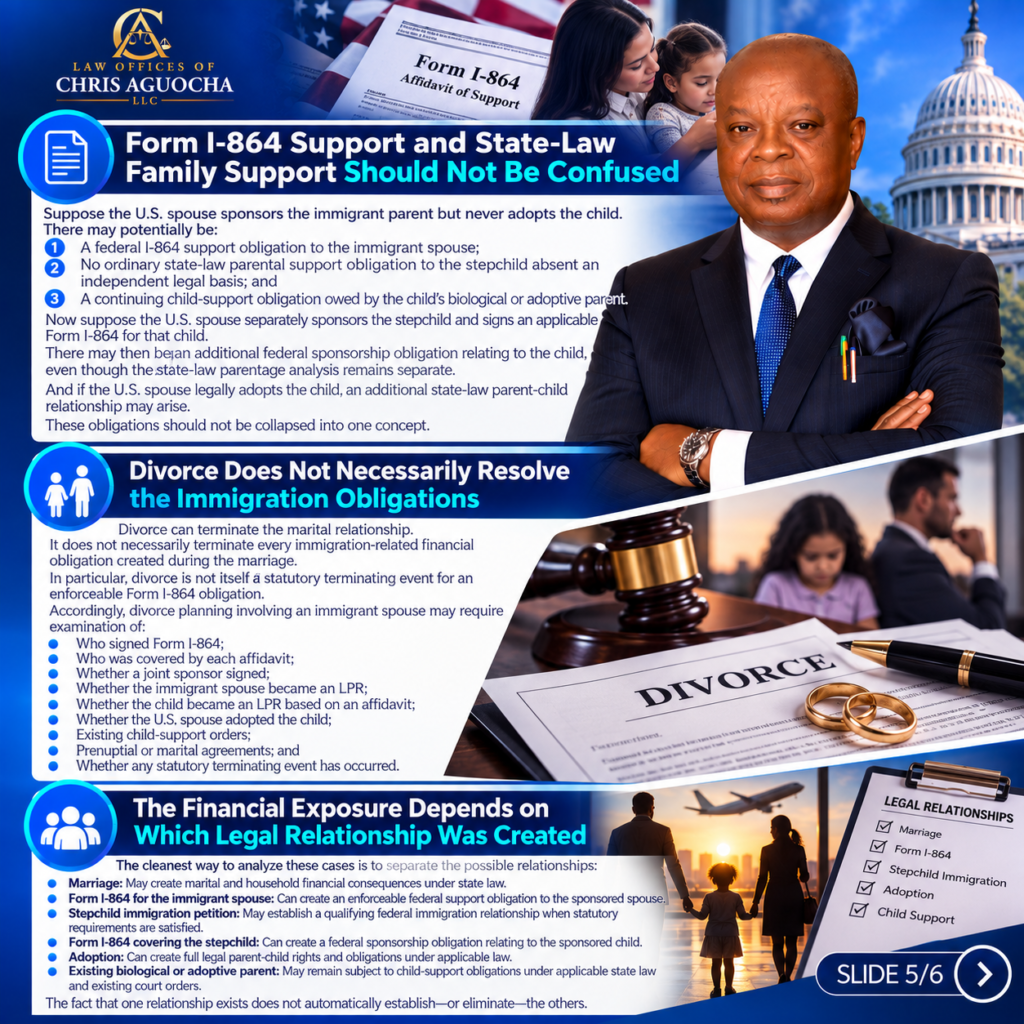
Form I-864 Support and State-Law Family Support Should Not Be Confused
Suppose the U.S. spouse sponsors the immigrant parent but never adopts the child.
There may potentially be:
- A federal I-864 support obligation to the immigrant spouse;
- No ordinary state-law parental support obligation to the stepchild absent an independent legal basis; and
- A continuing child-support obligation owed by the child’s biological or adoptive parent.
Now suppose the U.S. spouse separately sponsors the stepchild and signs an applicable Form I-864 for that child.
There may then be an additional federal sponsorship obligation relating to the child, even though the state-law parentage analysis remains separate.
And if the U.S. spouse legally adopts the child, an additional state-law parent-child relationship may arise.
These obligations should not be collapsed into one concept.
Divorce Does Not Necessarily Resolve the Immigration Obligations
Divorce can terminate the marital relationship.
It does not necessarily terminate every immigration-related financial obligation created during the marriage.
In particular, divorce is not itself a statutory terminating event for an enforceable Form I-864 obligation.
Accordingly, divorce planning involving an immigrant spouse may require examination of:
• Who signed Form I-864;
• Who was covered by each affidavit;
• Whether a joint sponsor signed;
• Whether the immigrant spouse became an LPR;
• Whether the child became an LPR based on an affidavit;
• Whether the U.S. spouse adopted the child;
• Existing child-support orders;
• Prenuptial or marital agreements; and
• Whether any statutory terminating event has occurred.
The Financial Exposure Depends on Which Legal Relationship Was Created
The cleanest way to analyze these cases is to separate the possible relationships:
Marriage: May create marital and household financial consequences under state law.
Form I-864 for the immigrant spouse: Can create an enforceable federal support obligation to the sponsored spouse.
Stepchild immigration petition: May establish a qualifying federal immigration relationship when statutory requirements are satisfied.
Form I-864 covering the stepchild: Can create a federal sponsorship obligation relating to the sponsored child.
Adoption: Can create full legal parent-child rights and obligations under applicable law.
Existing biological or adoptive parent: May remain subject to child-support obligations under applicable state law and existing court orders.
The fact that one relationship exists does not automatically establish—or eliminate—the others.
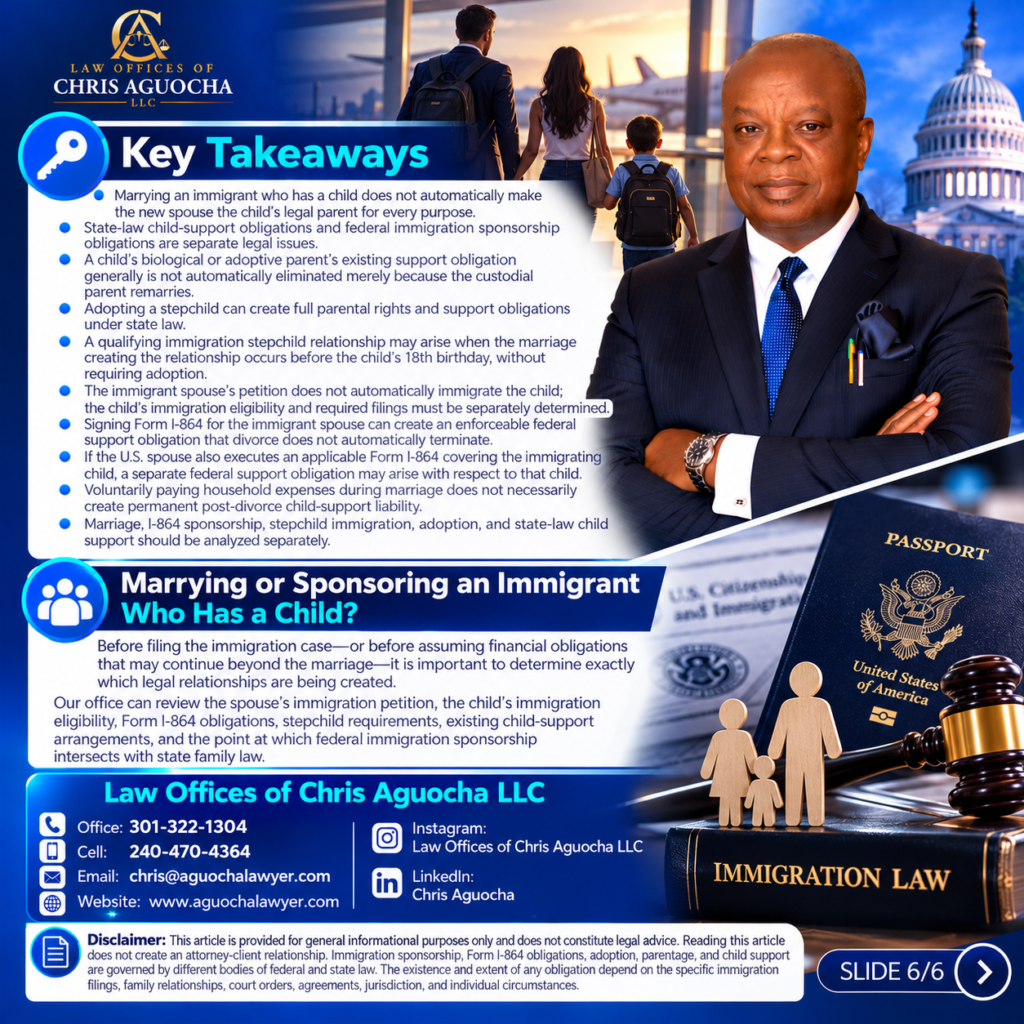
Key Takeaways
• Marrying an immigrant who has a child does not automatically make the new spouse the child’s legal parent for every purpose.
• State-law child-support obligations and federal immigration sponsorship obligations are separate legal issues.
• A child’s biological or adoptive parent’s existing support obligation generally is not automatically eliminated merely because the custodial parent remarries.
• Adopting a stepchild can create full parental rights and support obligations under state law.
• A qualifying immigration stepchild relationship may arise when the marriage creating the relationship occurs before the child’s 18th birthday, without requiring adoption.
• The immigrant spouse’s petition does not automatically immigrate the child; the child’s immigration eligibility and required filings must be separately determined.
• Signing Form I-864 for the immigrant spouse can create an enforceable federal support obligation that divorce does not automatically terminate.
• If the U.S. spouse also executes an applicable Form I-864 covering the immigrating child, a separate federal support obligation may arise with respect to that child.
• Voluntarily paying household expenses during marriage does not necessarily create permanent post-divorce child-support liability.
• Marriage, I-864 sponsorship, stepchild immigration, adoption, and state-law child support should be analyzed separately.
Marrying or Sponsoring an Immigrant Who Has a Child?
Before filing the immigration case—or before assuming financial obligations that may continue beyond the marriage—it is important to determine exactly which legal relationships are being created.
Our office can review the spouse’s immigration petition, the child’s immigration eligibility, Form I-864 obligations, stepchild requirements, existing child-support arrangements, and the point at which federal immigration sponsorship intersects with state family law.
Law Offices of Chris Aguocha LLC
Office: 301-322-1304
Cell: 240-470-4364
Email: chris@aguochalawyer.com
Disclaimer: This article is provided for general informational purposes only and does not constitute legal advice. Reading this article does not create an attorney-client relationship. Immigration sponsorship, Form I-864 obligations, adoption, parentage, and child support are governed by different bodies of federal and state law. The existence and extent of any obligation depend on the specific immigration filings, family relationships, court orders, agreements, jurisdiction, and individual circumstances.
