A major change to the rules governing international students is scheduled to take effect September 15, 2026.
The Department of Homeland Security’s final rule replaces the longstanding “duration of status,” or D/S, system for F, J, and I nonimmigrants with fixed periods of admission.
For F-1 students, the change makes immigration compliance increasingly dependent on specific dates. Students will need to pay particular attention to their Form I-94, Form I-20, program end date, extension-of-stay requirements, OPT or STEM OPT authorization, school transfers, program changes, international travel, and transition to another immigration status.
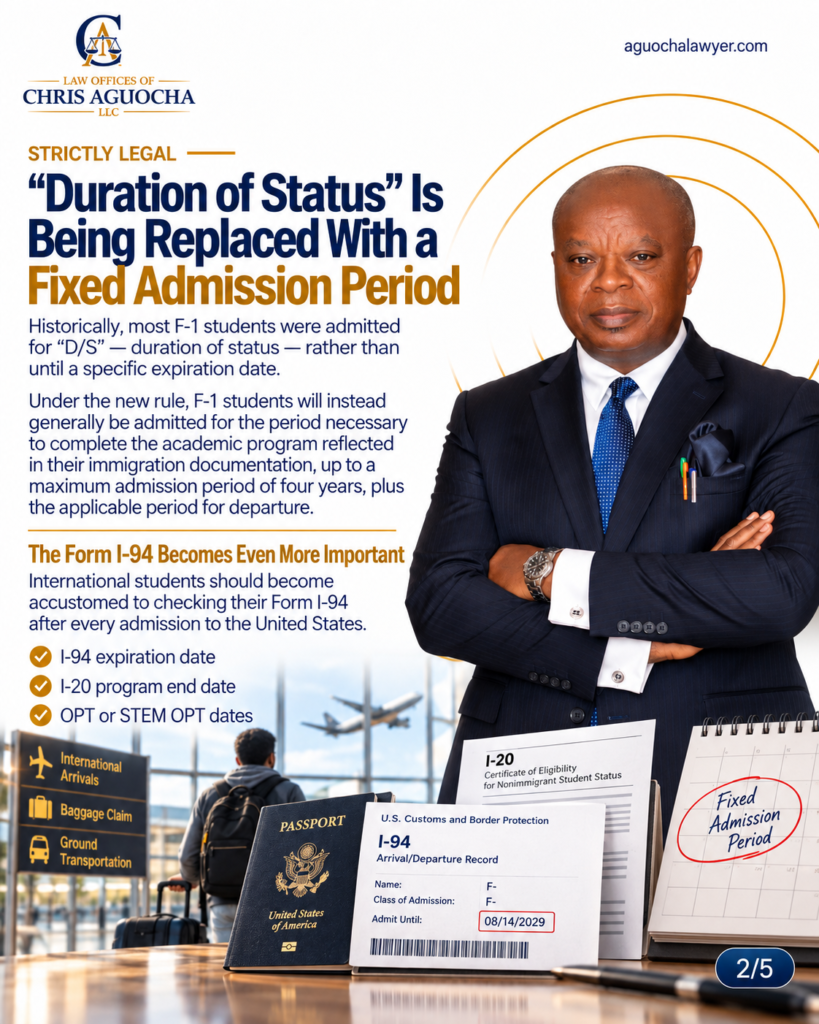
“Duration of Status” Is Being Replaced With a Fixed Admission Period
Historically, most F-1 students were admitted for “D/S”—duration of status—rather than until a specific expiration date.
Under the new rule, F-1 students will instead generally be admitted for the period necessary to complete the academic program reflected in their immigration documentation, up to a maximum admission period of four years, plus the applicable period for departure.
A student whose program legitimately requires additional time may therefore need to obtain an extension of stay from USCIS rather than relying solely on the school to extend the academic program in SEVIS.
This is a significant change.
Under the fixed-period system, the expiration of the student’s authorized admission period can have direct immigration consequences.
The Form I-94 Becomes Even More Important
International students should become accustomed to checking their Form I-94 after every admission to the United States.
The I-20 remains critically important, but students should not assume that an updated I-20 by itself necessarily extends the period of authorized stay reflected in the immigration record.
Students should therefore track several dates simultaneously:
• I-94 expiration date;
• I-20 program end date;
• OPT or STEM OPT dates;
• Employment Authorization Document expiration date;
• Extension-of-stay filing deadlines;
• Travel dates; and
• Any planned change to H-1B or another immigration classification.
A calendar mistake that once might primarily have been addressed through the school’s SEVIS procedures can now have more direct status consequences.
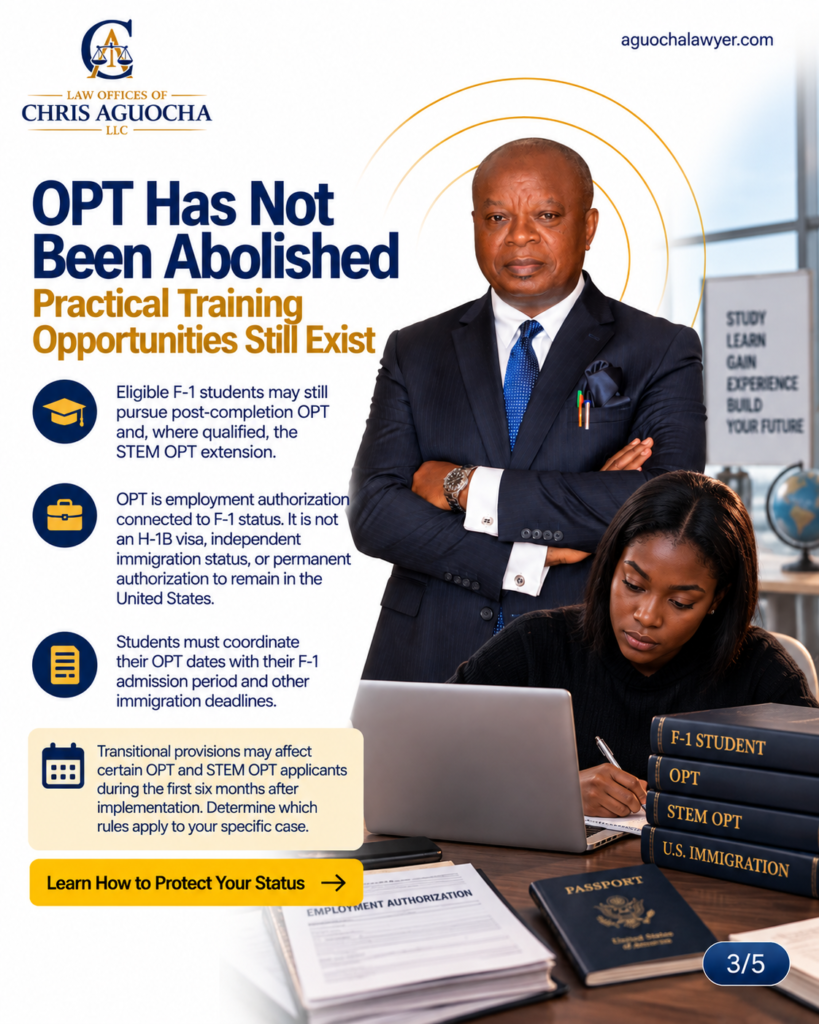
OPT Has Not Been Abolished
The final rule does not eliminate Optional Practical Training.
Eligible F-1 students may still pursue post-completion OPT and, where qualified, the STEM OPT extension.
But OPT is employment authorization connected to F-1 status. It is not an H-1B visa, independent immigration status, or permanent authorization to remain in the United States.
Students must therefore coordinate the underlying F-1 admission period with their practical-training authorization.
The final rule also contains transitional provisions affecting certain OPT and STEM OPT applicants during the first six months after implementation. Students affected by the transition should determine which rules apply to their particular filing rather than assuming that every student is treated identically.
A Job Offer Does Not Extend F-1 Status
An employer’s willingness to hire or sponsor an international graduate does not itself extend immigration status.
A student may have:
• A job offer;
• An employer willing to sponsor H-1B;
• An approved labor condition application;
• A pending employment-based strategy; or
• A long-term employer relationship;
and still have a separate F-1 status deadline that must be addressed.
The student’s immigration timeline and the employer’s sponsorship timeline must therefore be coordinated.
Students Who Need More Time May Need USCIS Approval
Students who cannot complete their authorized activity within the fixed admission period may need to seek an extension of stay.
The final rule permits extension procedures, but an extension should not be viewed as automatic simply because the school is willing to allow additional academic time.
Students should be prepared to establish eligibility under the applicable extension rules and file within the required period.
A timely filed extension request can also have important consequences for maintaining authorized study while USCIS adjudicates the application.
Changing Schools or Academic Programs Is Also More Restricted
The final rule is not limited to replacing D/S.
It also imposes new restrictions affecting certain school transfers and changes in educational objectives.
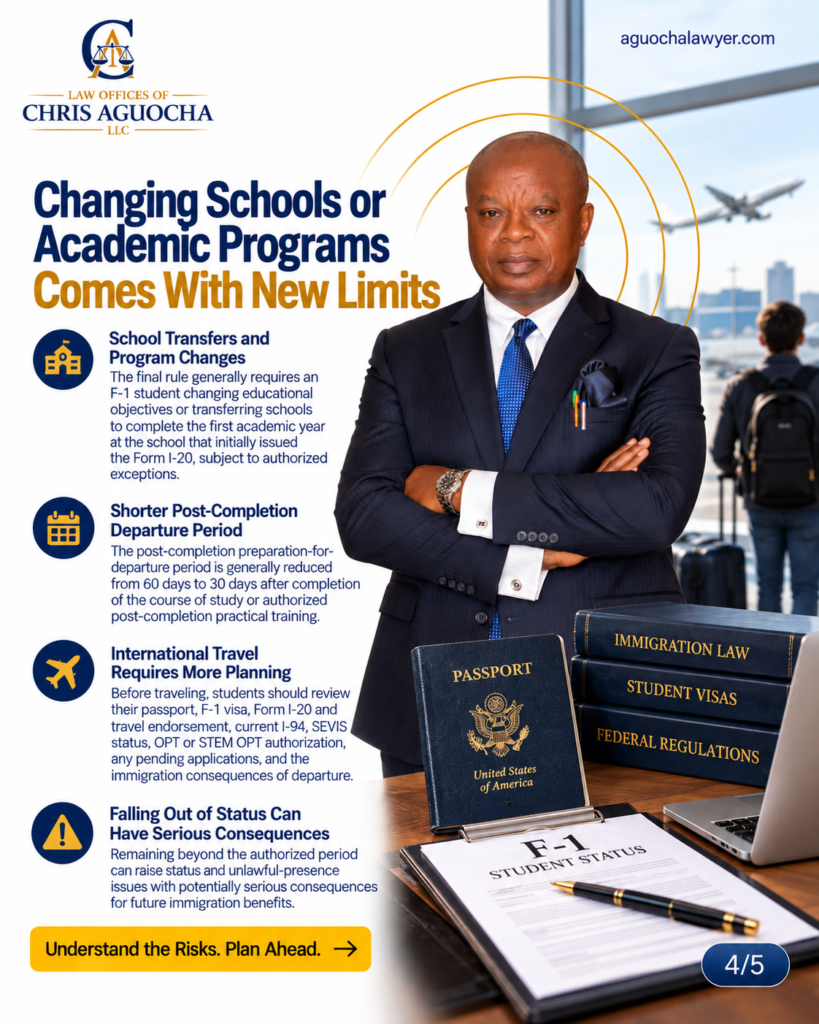
Among other provisions, the rule generally requires an F-1 student changing educational objectives or transferring schools to complete the first academic year at the school that initially issued the Form I-20, subject to authorized exceptions.
The final rule also imposes additional restrictions at the graduate level and on moving to the same or a lower educational level.
Students considering a transfer, change of major or program, second degree, or new educational level should therefore determine whether the proposed academic change is permitted before changing schools or programs.
The Post-Completion Departure Period Is Shorter
Another significant change is the reduction of the traditional F-1 post-completion preparation-for-departure period.
Under the final rule, the period generally decreases from 60 days to 30 days after completion of the course of study or authorized post-completion practical training.
That shorter period can materially affect planning for:
• Departure from the United States;
• Change of status;
• Employer sponsorship;
• Further education; and
• Other lawful immigration options.
Students should not continue relying on the traditional 60-day assumption without determining which rules apply to them.
International Travel Requires More Planning
Travel can also affect the student’s period of admission.
A student who departs the United States and seeks readmission after the new rule takes effect may receive a fixed admission period upon returning.
Before traveling, students should review:
• Passport validity;
• F-1 visa validity;
• Form I-20 and travel endorsement;
• Current I-94;
• SEVIS status;
• OPT or STEM OPT authorization;
• Employment documentation where applicable;
• Pending extension or change-of-status applications; and
• The immigration consequences of departure while an application is pending.
International travel should not be treated as merely a matter of having an unexpired F-1 visa.
Falling Out of Status May Carry Greater Consequences
One of DHS’s stated reasons for replacing D/S is to create specific admission periods that permit more direct monitoring of compliance.
Under a fixed-date system, remaining beyond the authorized period can raise status and unlawful-presence issues with potentially serious consequences for future:
• Visa applications;
• Admission to the United States;
• Extensions or changes of status;
• Employment-based immigration;
• Adjustment of status; and
• Other immigration benefits.
This makes early attention to the I-94 expiration date particularly important.
International Students Are Also an Important Part of the U.S. Economy
The immigration changes occur against the background of a substantial international-education sector.
According to the Institute of International Education, U.S. colleges and universities hosted 1,177,766 international students during the 2024–2025 academic year, including 294,253 students participating in OPT.
NAFSA estimated that international students contributed approximately $42.9 billion to the U.S. economy and supported 355,736 jobs during the 2024–2025 academic year.
Separate Fall 2025 estimates identified a decline of approximately $1.1 billion in economic contribution and nearly 23,000 supported jobs.
Those figures demonstrate the economic significance of international education. They should not, however, be interpreted to mean that the fixed-admission-period rule alone caused those changes.
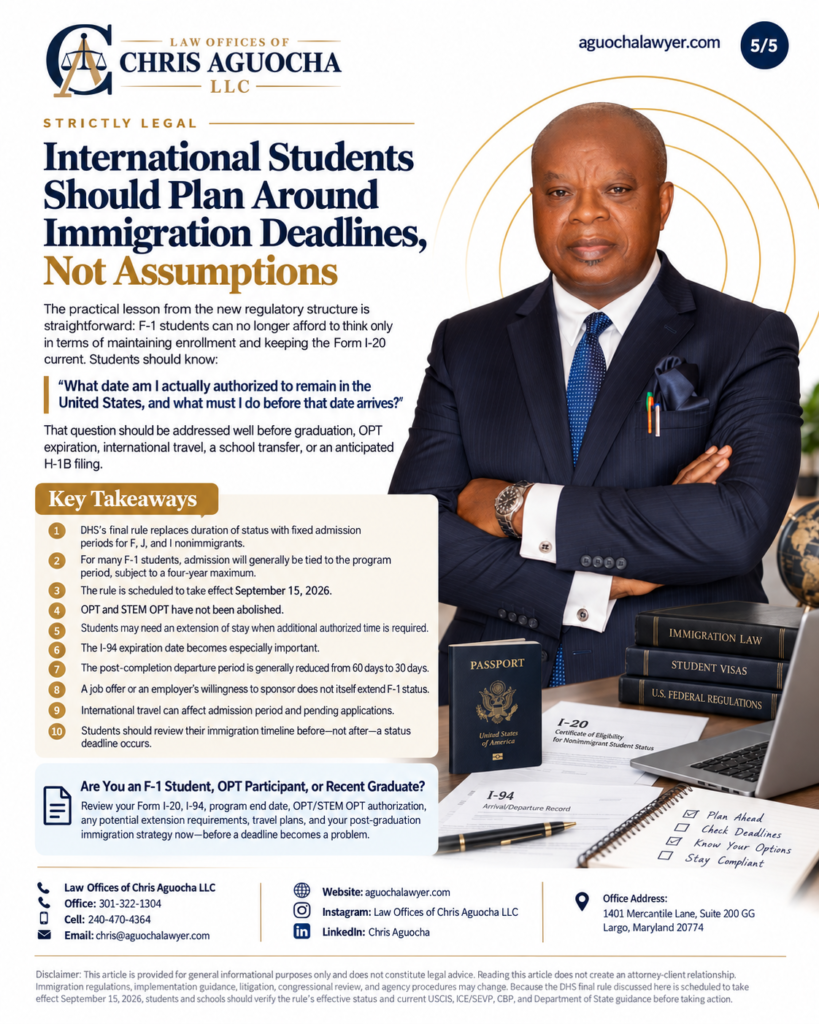
International Students Should Plan Around Immigration Deadlines, Not Assumptions
The practical lesson from the new regulatory structure is straightforward:
F-1 students can no longer afford to think only in terms of maintaining enrollment and keeping the Form I-20 current.
Students should know:
“What date am I actually authorized to remain in the United States, and what must I do before that date arrives?”
That question should be addressed well before graduation, OPT expiration, international travel, a school transfer, or an anticipated H-1B filing.
Key Takeaways
• DHS’s final rule replaces duration of status with fixed admission periods for F, J, and I nonimmigrants.
• For many F-1 students, admission will generally be tied to the program period, subject to a four-year maximum.
• The rule is scheduled to take effect September 15, 2026, subject to the congressional-review process and any subsequent DHS notice affecting the effective date.
• OPT and STEM OPT have not been abolished.
• Students may need an extension of stay when additional authorized time is required.
• The I-94 expiration date becomes especially important under the fixed-period system.
• The final rule also changes certain school-transfer, program-change, and educational-level rules.
• The post-completion departure period is generally reduced from 60 days to 30 days.
• A job offer or an employer’s willingness to sponsor does not itself extend F-1 status.
• International travel can affect the student’s admission period and pending immigration applications.
• International students should review their immigration timeline before—not after—a status deadline occurs.
Are You an F-1 Student, OPT Participant, or Recent Graduate?
If you are an F-1 student, recent graduate, OPT or STEM OPT participant, or prospective international student affected by these changes, consider reviewing your Form I-20, I-94, program end date, OPT/STEM OPT authorization, extension requirements, travel plans, and post-graduation immigration strategy before a deadline becomes an immigration problem.
Law Offices of Chris Aguocha LLC
Office: 301-322-1304
Cell: 240-470-4364
Email: chris@aguochalawyer.com
Disclaimer: This article is provided for general informational purposes only and does not constitute legal advice. Reading this article does not create an attorney-client relationship. Immigration regulations, implementation guidance, litigation, congressional review, and agency procedures may change. Because the DHS final rule discussed here is scheduled to take effect September 15, 2026, students and schools should verify the rule’s effective status and current USCIS, ICE/SEVP, CBP, and Department of State guidance before taking action.
