


Marriage-based immigration sponsorship can create a financial obligation that lasts far longer than many sponsors expect. Form I-864, Affidavit of Support Under Section 213A of the INA, is not merely evidence that the petitioner earns enough income to sponsor a spouse. It is a legally enforceable undertaking created under federal immigration law.
For a sponsor, joint sponsor, or sponsored immigrant, understanding when that obligation begins—and when it actually ends—can become especially important during separation or divorce.
Form I-864 Is a Contractual Obligation, Not Routine Immigration Paperwork
When a U.S. citizen or lawful permanent resident petitions for a spouse who is required to submit Form I-864, the sponsor agrees to provide financial support as required by federal law.
Signing the affidavit alone does not mean that every contemplated support obligation immediately becomes payable. The enforceable support obligation generally arises when the intending immigrant obtains lawful permanent resident status based on the affidavit of support.
Once the obligation becomes effective, however, it can continue for years.
Most importantly:
Divorce does not automatically terminate the Form I-864 obligation.
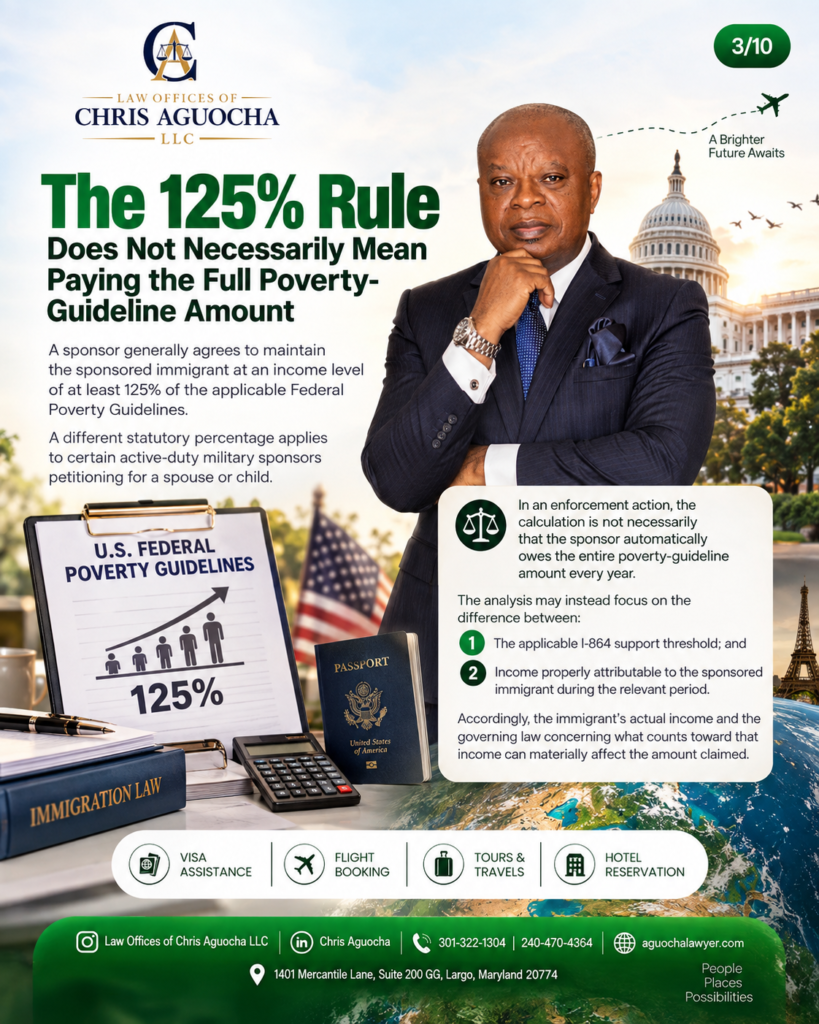
The 125% Rule Does Not Necessarily Mean Paying the Full Poverty-Guideline Amount
A sponsor generally agrees to maintain the sponsored immigrant at an income level of at least 125% of the applicable Federal Poverty Guidelines. A different statutory percentage applies to certain active-duty military sponsors petitioning for a spouse or child.
In an enforcement action, the calculation is not necessarily that the sponsor automatically owes the entire poverty-guideline amount every year.
The analysis may instead focus on the difference between:
- The applicable I-864 support threshold; and
- Income properly attributable to the sponsored immigrant during the relevant period.
Accordingly, the immigrant’s actual income and the governing law concerning what counts toward that income can materially affect the amount claimed.
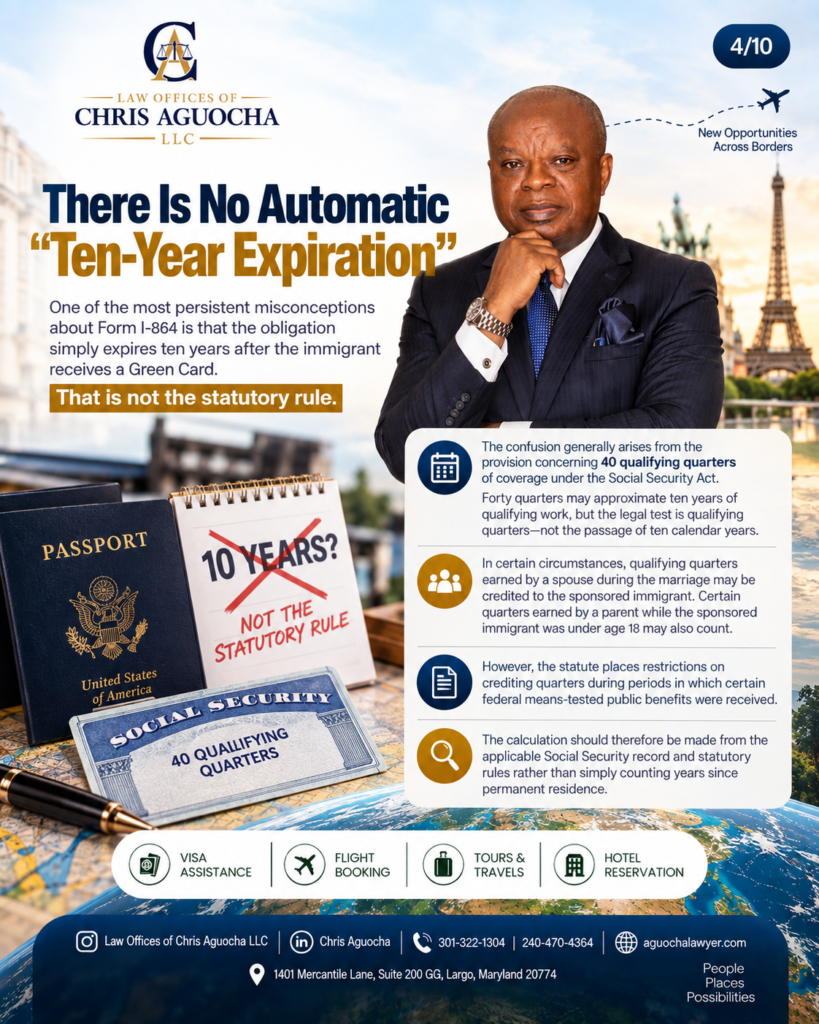
There Is No Automatic “Ten-Year Expiration”
One of the most persistent misconceptions about Form I-864 is that the obligation simply expires ten years after the immigrant receives a Green Card.
That is not the statutory rule.
The confusion generally arises from the provision concerning 40 qualifying quarters of coverage under the Social Security Act. Forty quarters may approximate ten years of qualifying work, but the legal test is qualifying quarters—not the passage of ten calendar years.
In certain circumstances, qualifying quarters earned by a spouse during the marriage may be credited to the sponsored immigrant. Certain quarters earned by a parent while the sponsored immigrant was under age 18 may also count.
However, the statute places restrictions on crediting quarters during periods in which certain federal means-tested public benefits were received. The calculation should therefore be made from the applicable Social Security record and statutory rules rather than simply counting years since permanent residence.
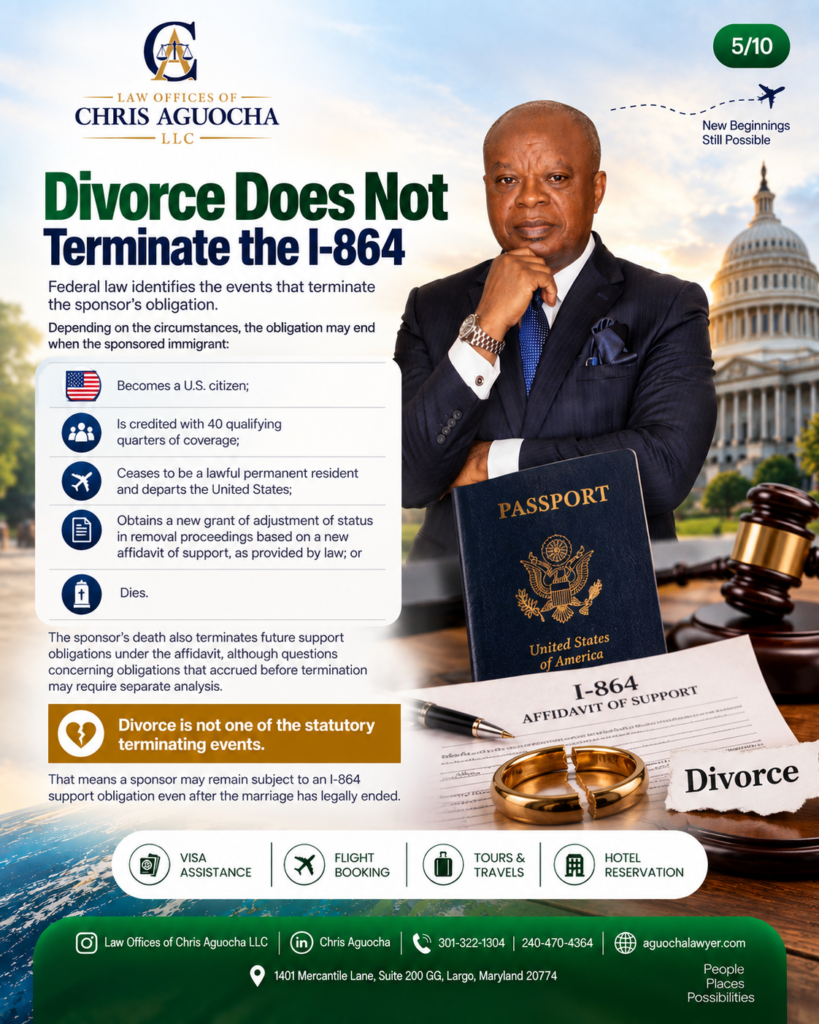
Divorce Does Not Terminate the I-864
Federal law identifies the events that terminate the sponsor’s obligation.
Depending on the circumstances, the obligation may end when the sponsored immigrant:
• Becomes a U.S. citizen;
• Is credited with 40 qualifying quarters of coverage;
• Ceases to be a lawful permanent resident and departs the United States;
• Obtains a new grant of adjustment of status in removal proceedings based on a new affidavit of support, as provided by law; or
• Dies.
The sponsor’s death also terminates future support obligations under the affidavit, although questions concerning obligations that accrued before termination may require separate analysis.
Divorce is not one of the statutory terminating events.
That means a sponsor may remain subject to an I-864 support obligation even after the marriage has legally ended.
A Prenuptial Agreement or Divorce Settlement Should Not Automatically Be Assumed to Eliminate I-864 Liability
Another important issue arises when spouses have signed:
• A prenuptial agreement;
• A postnuptial agreement;
• A marital settlement agreement;
• A waiver of alimony; or
• A divorce decree resolving financial support.
Form I-864 creates a federal obligation distinct from ordinary state-law alimony.
Accordingly, a provision waiving spousal support should not automatically be assumed to waive an I-864 claim. Courts have addressed the interaction between private agreements and federal I-864 rights in different factual and procedural settings.
The precise language of the agreement, governing precedent, jurisdiction, and nature of the asserted waiver should therefore be reviewed before either party assumes the federal obligation has disappeared.
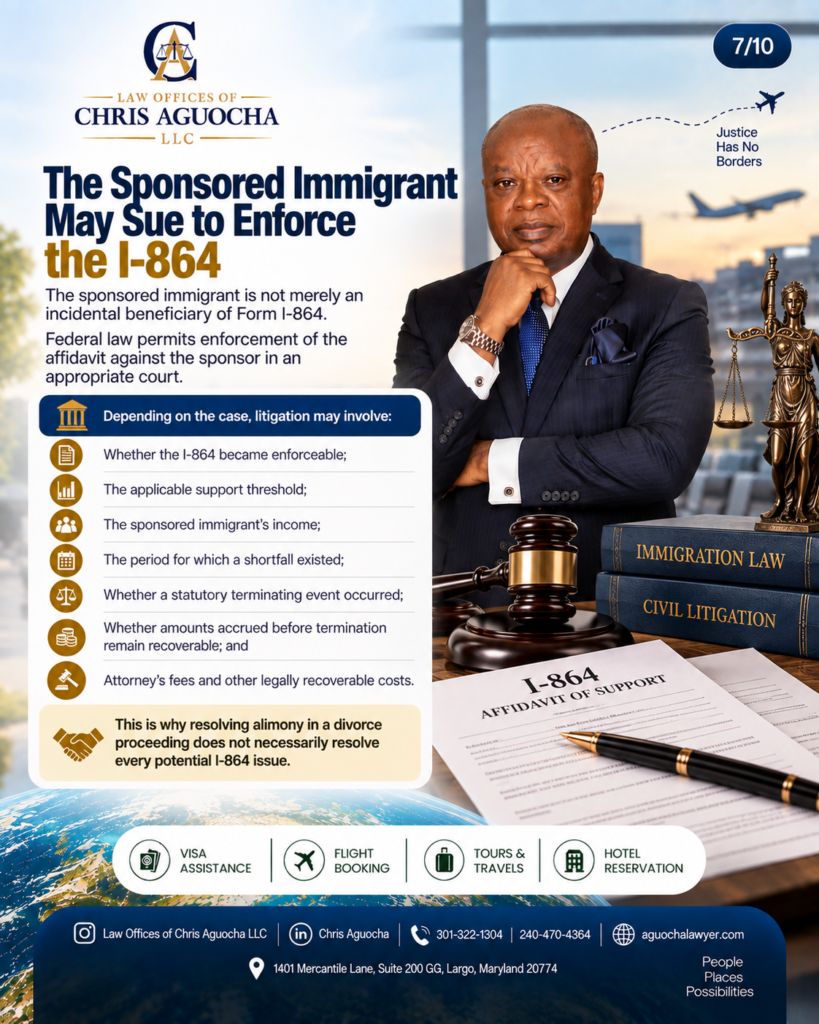
The Sponsored Immigrant May Sue to Enforce the I-864
The sponsored immigrant is not merely an incidental beneficiary of Form I-864.
Federal law permits enforcement of the affidavit against the sponsor in an appropriate court.
Depending on the case, litigation may involve:
• Whether the I-864 became enforceable;
• The applicable support threshold;
• The sponsored immigrant’s income;
• The period for which a shortfall existed;
• Whether a statutory terminating event occurred;
• Whether amounts accrued before termination remain recoverable; and
• Attorney’s fees and other legally recoverable costs.
This is why resolving alimony in a divorce proceeding does not necessarily resolve every potential I-864 issue.
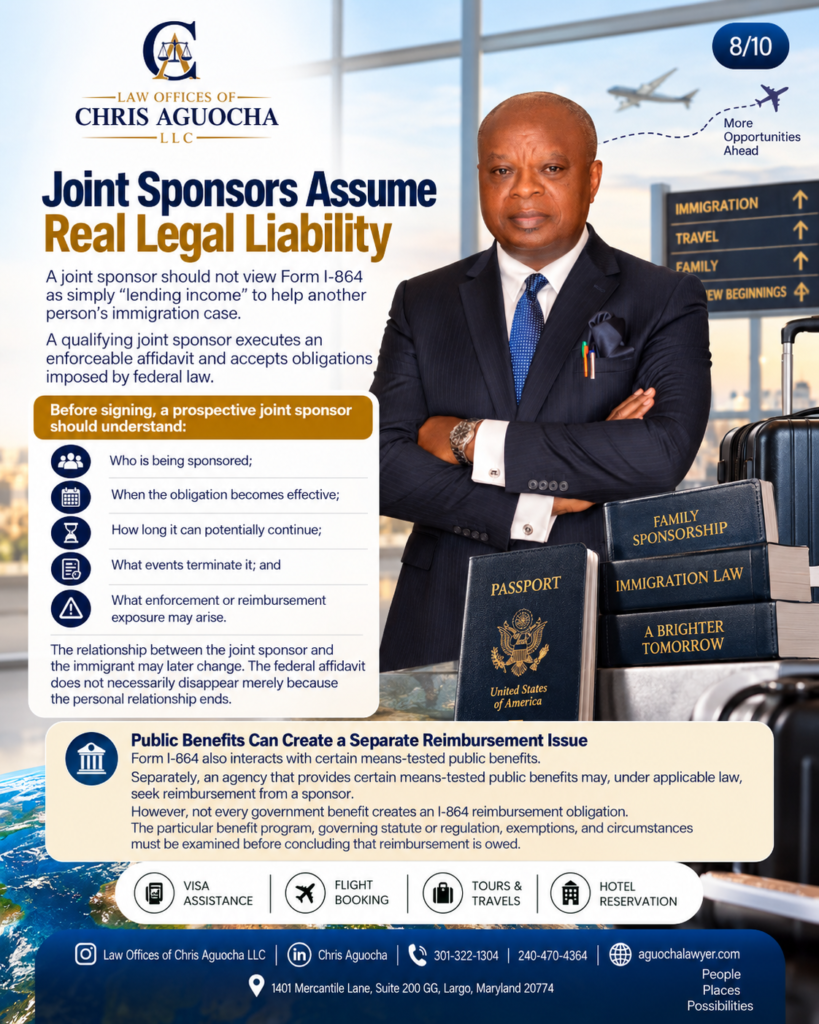
Joint Sponsors Assume Real Legal Liability
A joint sponsor should not view Form I-864 as simply “lending income” to help another person’s immigration case.
A qualifying joint sponsor executes an enforceable affidavit and accepts obligations imposed by federal law.
Before signing, a prospective joint sponsor should understand:
• Who is being sponsored;
• When the obligation becomes effective;
• How long it can potentially continue;
• What events terminate it; and
• What enforcement or reimbursement exposure may arise.
The relationship between the joint sponsor and the immigrant may later change. The federal affidavit does not necessarily disappear merely because the personal relationship ends.
Public Benefits Can Create a Separate Reimbursement Issue
Form I-864 also interacts with certain means-tested public benefits.
Depending on the particular program and applicable law, the sponsor’s income and assets may be deemed available to the sponsored immigrant when eligibility is determined.
Separately, an agency that provides certain means-tested public benefits may, under applicable law, seek reimbursement from a sponsor.
However, not every government benefit creates an I-864 reimbursement obligation. The particular benefit program, governing statute or regulation, exemptions, and circumstances must be examined before concluding that reimbursement is owed.
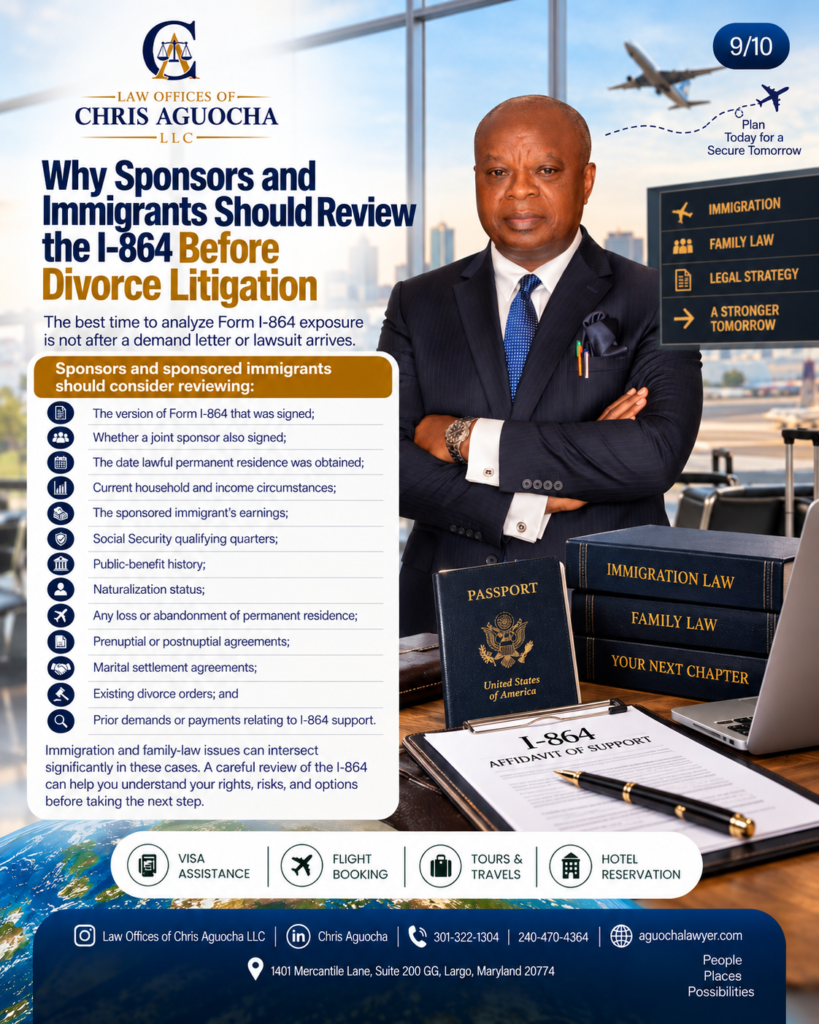
Why Sponsors and Immigrants Should Review the I-864 Before Divorce Litigation
The best time to analyze Form I-864 exposure is not after a demand letter or lawsuit arrives.
Sponsors and sponsored immigrants should consider reviewing:
• The version of Form I-864 that was signed;
• Whether a joint sponsor also signed;
• The date lawful permanent residence was obtained;
• Current household and income circumstances;
• The sponsored immigrant’s earnings;
• Social Security qualifying quarters;
• Public-benefit history;
• Naturalization status;
• Any loss or abandonment of permanent residence;
• Prenuptial or postnuptial agreements;
• Marital settlement agreements;
• Existing divorce orders; and
• Prior demands or payments relating to I-864 support.
Immigration and family-law issues can intersect significantly in these cases.
Key Takeaways
• Form I-864 creates a legally enforceable federal support obligation; it is not merely proof of sufficient income for immigration purposes.
• The enforceable obligation generally becomes operative when the sponsored immigrant obtains lawful permanent residence based on the affidavit—not simply when the sponsor signs the form.
• The obligation does not automatically expire ten years after Green Card approval. Forty qualifying quarters are a statutory termination mechanism, not a ten-year clock.
• Divorce does not terminate the I-864 obligation.
• The sponsored immigrant may bring a civil action to enforce the affidavit.
• A waiver of alimony or other private marital agreement should not automatically be assumed to eliminate federal I-864 rights.
• Joint sponsors undertake genuine legal obligations and should understand the potential duration and consequences before signing.
• Certain government agencies may have reimbursement rights involving qualifying means-tested public benefits, but not every public benefit creates reimbursement liability.
• A terminating event may end future obligations without necessarily eliminating amounts that accrued beforehand.
Facing an I-864 Sponsorship or Enforcement Issue?
If you are preparing to sign Form I-864, considering becoming a joint sponsor, negotiating a divorce or marital settlement agreement, responding to an I-864 demand, or determining whether an existing sponsorship obligation has terminated, the immigration and financial consequences should be evaluated before taking a legal position that may be difficult to reverse.
Law Offices of Chris Aguocha LLC
Office: 301-322-1304
Cell: 240-470-4364
Email: chris@aguochalawyer.com
Website: www.aguochalawyer.com
Disclaimer: This article is provided for general informational purposes only and does not constitute legal advice. Reading this article does not create an attorney-client relationship. Form I-864 enforcement involves federal immigration law and may also intersect with state family law, contract law, public-benefit law, and jurisdiction-specific precedent. Every matter should be evaluated based on its particular facts and governing law.
